

Summary
Artificial intelligence (AI) offers unparalleled opportunities for innovation, efficiency, and growth, but scaling AI initiatives remains a complex challenge for many organisations. Without the right operating model and a clear framework for alignment, AI efforts often result in fragmented systems, inconsistent outcomes, and missed strategic opportunities.
This paper explores how AI orchestration, when supported by the right operating model and alignment framework, can transform these challenges into opportunities. By unifying
tools, automating workflows, and embedding governance throughout the AI lifecycle, orchestration enables businesses to scale AI efficiently while ensuring alignment with
broader strategic goals.
Key areas covered include:
- The critical role of AI orchestration in overcoming common scaling barriers and achieving business impact.
- The importance of aligning technology advancements with a cohesive operating model to enable sustainable transformation.
- Insights into AI maturity and how organisations can progress towards enterprise-wide scalability.
- The role of effective tooling in supporting seamless orchestration across systems.
- Emerging trends shaping the future of AI orchestration, from autonomous systems to privacy-preserving AI.
Read on to discover how through Mozaic’s proven expertise and approach to orchestration, organisations can unlock the true value of AI, mitigate business risks, and position themselves to be agile, efficient, and Future Ready.
Introduction: Orchestrating AI for Scalable Success
The promise of AI is vast—enhancing decision-making, improving efficiency, and driving innovation across industries. However, as businesses scale their AI initiatives, many find that managing multiple AI systems becomes increasingly complex. Disjointed tools and fragmented processes create silos, slow down time-to-value, and lead to inefficiencies that limit AI’s full potential and introduce fresh business risks. Scaling AI requires more than just deploying advanced tools or models. It demands an operating model that aligns technology, processes, and people with the organisation’s broader goals. Without this alignment, AI initiatives risk becoming siloed experiments that fail to deliver on their potential.
AI orchestration provides the solution. Much like the orchestration of industrial processes during past technological revolutions, AI orchestration ensures that diverse AI systems work together harmoniously, enabling scalability and operational excellence. By coordinating workflows, automating processes, and embedding governance across the AI lifecycle, orchestration transforms fragmented efforts into a unified, scalable system. When supported by a cohesive operating model, AI orchestration becomes a strategic enabler, ensuring AI initiatives are efficient, agile, and aligned with business priorities.
This paper explores the challenges organisations face in scaling AI, the maturity journey required to progress, and how AI orchestration—grounded in foundational principles and enabled by the right tools—can position organisations for long-term success.
Challenges In Scaling AI
While AI holds tremendous potential, organisations face significant hurdles in scaling their initiatives from isolated proofs of concept to enterprise-wide impact. These challenges often result in inefficiencies, missed opportunities, and increased business risks that must be actively managed to ensure success.
Fragmented Solutions: AI initiatives are often launched in silos, with different teams or departments developing and deploying AI models independently. While multiple AI tools may be necessary to enable different parts of the value stream, this can lead to duplication of effort, inconsistent business outcomes, and a lack of alignment across the organisation (See Fig 1). There is a risk that fragmentation increases operational inefficiencies, dilutes the overall impact of AI investments, and undermines strategic objectives by delivering conflicting insights. In recent reporting, one large financial services organisation had multiple AI initiatives across departments, duplicating processes and efforts, and leading to inconsistent client insights.
Complexity In Managing Multiple AI Tools: With various teams using different tools, frameworks, and workflows, managing and scaling AI becomes increasingly complex. Ensuring compatibility and integration between these tools adds to operational overhead, delaying time-to-value. There is a risk that the complexity introduced adds to the likelihood of project delays, higher costs, and failures to integrate critical insights into decision-making processes. A recent industry survey found that only 20% of companies achieve ROI from AI at scale, often due to the complexity of coordinating disparate systems.
Inconsistent Governance and Compliance: As AI initiatives grow in complexity, maintaining consistent governance across projects becomes a major challenge. Regulations like GDPR and ethical considerations add layers of scrutiny, particularly in industries handling sensitive data. There is a risk that poor governance exposes organisations to regulatory penalties, reputational damage, and the erosion of trust in AI-driven decisions. According to recent findings, nearly half of all AI projects in regulated sectors experience delays due to compliance issues, highlighting the risks associated with inconsistent governance.
Difficulty in Scaling Beyond Initial Use Cases: AI often proves effective in small- scale pilots or individual departments but struggles to scale across the organisation. Limited infrastructure, lack of resource allocation, culture challenges, and disconnected workflows prevent AI from achieving enterprise-wide impact. There is a risk that the inability to scale AI creates opportunity costs, as organisations fail to fully leverage the value of their data and resources. For example, only a small fraction of companies succeed in moving AI beyond pilot projects to enterprise-wide deployment, often citing inadequate infrastructure as a limiting factor.
Slow Time to Value: Fragmented workflows and inconsistent processes delay the realisation of meaningful outcomes from AI initiatives. Disconnected data pipelines and a lack of automation prevent organisations from deploying AI solutions quickly. There is a risk that extended delays reduce the competitive advantage AI can bring, increasing the chance competitors will capitalise on similar initiatives more effectively. Research shows that nearly 40% of organisations report that AI projects take longer than expected to yield results, with disjointed workflows and data challenges often cited as the primary culprits.
Resource Inefficiency: Uncoordinated AI efforts often lead to spiralling operational costs (and computational power), with duplicated processes and underutilised resources increasing inefficiency. There is a risk that inefficiency drains budgets, limits scalability, and prevents organisations from reallocating resources to higher-value initiatives. For instance, studies indicate that 60% of organisations experience inflated costs due to duplicated AI processes and resource-heavy workflows.
Overcoming these challenges demands a cohesive approach like AI orchestration, which integrates tools, workflows, and governance to deliver enterprise-wide impact.
Defining AI Orchestration
AI orchestration is the process of automating and coordinating AI workflows across systems, tools, and teams to ensure they work seamlessly at scale. Unlike siloed AI initiatives, orchestration unifies disparate efforts into a cohesive framework that drives consistent, reliable outcomes.
Key characteristics of AI orchestration include:
- Centralised Workflow Management: Orchestration automates and streamlines AI workflows, reducing manual intervention and ensuring consistency across deployments.
- Integration Across Systems: By connecting AI models, data pipelines, and business systems, orchestration ensures seamless collaboration between technology and operational processes.
- Governance and Monitoring: Orchestration integrates governance and monitoring throughout the AI lifecycle, ensuring ethical use, regulatory compliance, and consistent performance across systems.
When supported by an aligned operating model, AI orchestration enables organisations to scale AI efficiently, integrate it into core business processes, and align initiatives with strategic objectives.
Strategic Positioning & Decisions On AI Use Cases
The ability to target specific business outcomes with AI and refine models to deliver context-specific insights is a critical capability for organisations.
These decisions should not sit in isolated silos but must be integrated into a broader strategy, supported by cohesive operating models and effective orchestration.
This alignment ensures AI investments are directed at the most impactful opportunities, accelerating the journey toward enterprise-wide maturity.
AI Maturity: Readiness for Scalable AI
Understanding an organisation’s AI maturity is a critical first step in preparing for enterprise-wide orchestration. Many organisations find themselves at different stages of the maturity curve, ranging from experimental pilots to operational AI initiatives, yet struggle to achieve scalability. Without a clear understanding of their current landscape and alignment to strategic goals, organisations risk misaligned investments and underperforming initiatives.
Mozaic’s Maturity Assessment Framework
Mozaic’s comprehensive maturity assessment provides organisations with a clear understanding of their AI landscape. Built on a detailed framework, this model evaluates:
- The current state of AI initiatives, including alignment with business objectives.
- The quality and accessibility of foundational elements such as data readiness, infrastructure, and governance.
- Key gaps and barriers that must be addressed to progress toward scalable, impactful AI.
By mapping an organisation’s maturity, Mozaic helps identify actionable steps to advance to the next stage. This approach ensures that AI investments are directed at initiatives with the highest potential for enterprise-wide value.
The maturity assessment not only provides clarity on where an organisation stands today but also serves as a precursor to building the foundational elements required for AI orchestration. By understanding their maturity, organisations can confidently proceed to develop the structures, processes, and technologies needed to scale AI effectively.
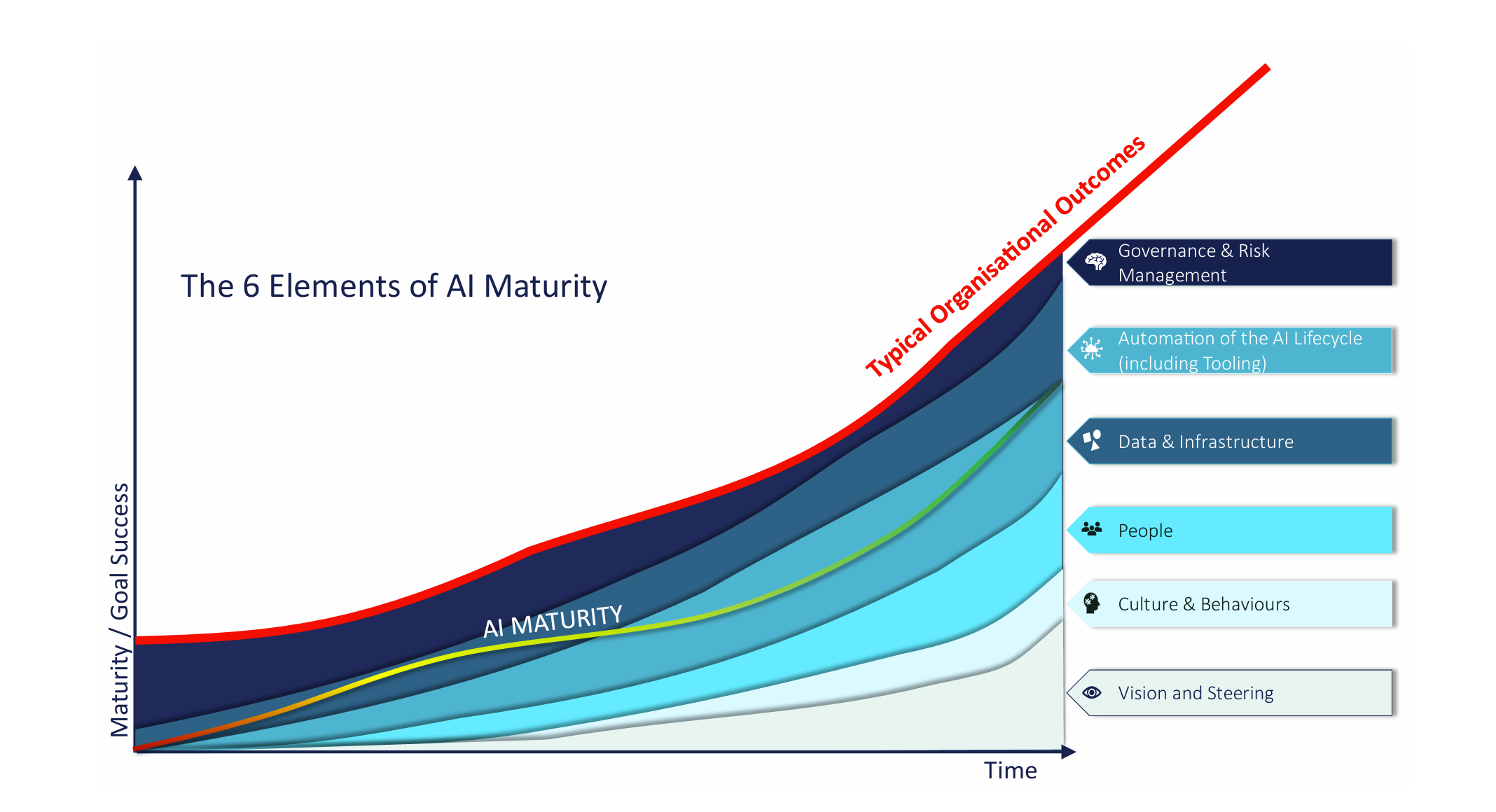
Foundations of AI Orchestration
With a clear understanding of an organisation’s AI maturity, the next step is to build the foundational elements required for scalable orchestration, ensuring enterprise-wide impact.
Implementing effective AI orchestration requires a strong foundation that starts with vision and encompasses culture & behaviours, people, scalable infrastructure, data readiness, automated workflows, AI&ML tools and robust governance frameworks. Each of these elements ensures that AI systems operate efficiently, ethically, and in alignment with broader business goals. The following describes these foundations:
Vision, Culture, Behaviours, and People
For AI orchestration to succeed, it must be driven by a clear vision and supported by a culture that embraces innovation and responsible AI practices. The behaviours and skills of individuals within an organisation play a crucial role in fostering maturity.
Vision and Strategic Alignment: A strong vision articulates how AI will contribute to achieving long-term business outcomes. Leadership should clearly define and communicate the role of AI, aligning it with organisational priorities to ensure that stakeholders are committed to a cohesive strategy. This vision acts as the guiding principle for investment decisions, resource allocation, and performance evaluation.
Culture of Innovation and Responsibility: AI orchestration thrives in a culture that values experimentation, continuous learning, and ethical responsibility. Leaders must cultivate an environment where teams feel empowered to leverage AI tools and methodologies while adhering to principles of transparency, fairness, and accountability. This culture should promote cross-functional collaboration, enabling diverse perspectives to enhance AI outcomes and mitigate bias.
Adaptive Behaviours: The behaviours within an organisation need to evolve alongside its AI initiatives. Teams should demonstrate adaptability, embracing iterative cycles and feedback loops that are integral to AI development. Encouraging a mindset that prioritises agility and resilience helps organisations respond effectively to changes in AI technology and market demands.
People and Skills Development: Equipping teams with the right skills is paramount for effective AI orchestration. Organisations must invest in upskilling their workforce, focusing on data literacy, AI ethics, and technical proficiency in machine learning and data engineering. Leaders should foster a blend of technical and domain-specific expertise to ensure AI solutions are practical and aligned with industry needs.
Leadership and Change Management: Effective AI orchestration requires strong leadership that not only sets the vision but also leads by example. Leaders should champion AI initiatives, drive change management efforts, and bridge any gaps between technical teams and business units. This proactive approach helps align AI projects with broader strategic goals and encourages buy-in at all organisational levels.
Data and Infrastructure
Data and infrastructure are central to AI orchestration. For AI to operate seamlessly and deliver value at scale, data must be accessible, high-quality, and integrated across systems, while infrastructure must support growing computational demands.
Data Readiness and Quality: AI orchestration depends on data that is clean, consistent, and readily available. Fragmented or siloed data can delay AI workflows and reduce model accuracy. Orchestration platforms integrate data from diverse sources, ensuring it is aggregated, cleaned, and transformed in real time to support accurate, efficient AI processes.
Scalable Infrastructure: As AI models grow in complexity, scalable infrastructure is essential. Cloud-native architectures enable flexibility, allowing AI systems to scale based on real-time needs. By orchestrating data and resources through scalable cloud environments, organisations reduce costs and avoid inefficiencies associated with rigid, static infrastructure.
Interoperability: AI orchestration ensures seamless communication between AI models, data pipelines, and business systems. By enabling integration with legacy systems and third-party tools, orchestration platforms break down data silos and enable AI-driven insights to be embedded directly into workflows.
Automation of the AI Lifecycle
Automation is at the heart of AI orchestration. By automating key stages in the AI lifecycle, from data ingestion and preprocessing to model training and deployment, organisations can accelerate workflows, minimise human error, and enhance resource efficiency.
End-To-End Automation: AI orchestration platforms automate the full lifecycle, removing manual steps that slow down model development and deployment. This end- to-end automation improves consistency and speeds up the process, ensuring AI models are deployed quickly and reliably.
CI/CD for AI: Continuous Integration and Continuous Delivery (CI/CD) pipelines for AI allow models to be retrained, validated, and deployed in a repeatable manner. This ensures that AI systems remain up-to-date and aligned with evolving data and business requirements.
Tooling: There are many tools that can be leveraged to orchestrate your AI, some of which are outlined as follows and will often be combined to form the tooling component of AI Orchestration –
- Airflow + DAGsHub: A combination that supports reproducible AI workflow management and version control, providing an integrated environment for data and model orchestration.
- Apache Airflow: An open-source platform used to programmatically author, schedule, and monitor workflows. Ideal for orchestrating complex data pipelines and ensuring data flow across different processes.
- Apache NiFi: Known for real-time data flow orchestration, enabling the management of data streams between different systems and ensuring data readiness for AI processes.
- Azure Machine Learning: A comprehensive service that facilitates end-to-end ML workflows, supporting orchestration, automated model retraining, and integration with CI/CD pipelines.
- Databricks: A cloud-based platform that unifies data engineering and ML tasks, offering seamless orchestration of data pipelines and model management.
- Kubernetes: Utilised for container orchestration, it is essential for deploying and scaling machine learning (ML) models across different environments with high availability and automated management.
- Kubeflow: A popular choice for managing ML workflows, allowing easy training, deployment, and scaling of ML models on Kubernetes.
- MLflow: An open-source platform that manages the ML lifecycle, including tracking experiments, packaging code, and deploying models.
Governance and Risk Management
A strong governance framework is essential for the ethical and compliant use of AI. AI orchestration platforms enforce governance standards across workflows, helping organisations mitigate risks related to data privacy, model bias, and regulatory compliance.
Consistent Governance: Orchestration platforms apply governance controls across AI initiatives, ensuring that AI models comply with regulatory standards and ethical principles. Consistent governance builds trust in AI insights and safeguards against legal and reputational risks.
Risk Mitigation: By monitoring model performance and enforcing compliance measures, AI orchestration helps organisations manage risks associated with AI systems, such as data privacy and model transparency. Automated governance also ensures that AI-driven decisions remain explainable, accountable, and secure.
Delivering Business Impact Through AI Orchestration
AI orchestration transforms fragmented efforts into a unified system that drives measurable business outcomes. By integrating AI into core business processes and aligning it with organisational goals, orchestration enables organisations to achieve operational efficiency, improve decision-making, and enhance adaptability in the face of change.
Driving Operational Efficiency: AI orchestration simplifies and automates workflows, reducing inefficiencies and optimising resource utilisation. Organisations can eliminate manual redundancies, improve consistency, and scale AI initiatives more effectively. In retail, orchestration integrates demand forecasting models with supply chain management systems, reducing stockouts and optimising inventory levels.
Enhanced Decision-Making: AI orchestration ensures that actionable insights are delivered directly to decision-makers in real time. By embedding AI outputs into existing business systems, organisations can respond faster and more effectively to changing conditions. In healthcare, orchestration automates the aggregation of patient data from multiple sources, enabling real-time insights for personalised treatment plans.
Enabling Agility and Innovation: With orchestration in place, organisations are better equipped to adapt to evolving business needs and technological advancements. Scalable workflows and dynamic governance frameworks ensure that AI initiatives remain relevant and impactful. In financial services, orchestration enables continuous model retraining to respond to emerging fraud patterns, ensuring resilience in a rapidly changing landscape.
Delivering Measurable Value: The adoption of AI orchestration results in tangible business benefits, from cost savings and process efficiencies to enhanced customer satisfaction. By aligning AI workflows with strategic objectives, organisations can achieve meaningful, measurable outcomes. In manufacturing, orchestration streamlines predictive maintenance by integrating sensor data from IoT devices with AI models. This approach reduces equipment downtime by anticipating failures before they occur, resulting in significant cost savings and increased production efficiency.
Emerging Trends and the Future of AI Orchestration
AI is rapidly evolving, and several trends are shaping the future of orchestration. While this paper highlights key developments, we will explore these in greater depth in a future publication:
- Autonomous AI Systems: AI models are advancing towards self-managed workflows, reducing the need for manual oversight and enabling greater focus on strategic initiatives.
- Privacy-Preserving AI: Technologies like federated learning allow organisations to train models without exposing sensitive data, ensuring compliance and building trust.
- Quantum AI Orchestration: Quantum computing promises breakthroughs in optimisation and predictive analytics, demanding orchestration systems ready to integrate quantum capabilities.
- Real-Time Decision Automation: AI is increasingly used for real-time insights, enabling immediate, data-driven actions in industries like finance, logistics, and retail.
- Convergence with Emerging Technologies: AI is merging with IoT, blockchain, and edge computing, creating opportunities to orchestrate complex, multi-technology environments.
These trends underline the importance of building adaptable orchestration frameworks today. In a subsequent paper, we will explore these advancements in more detail, providing actionable insights into their implications for business transformation.
Conclusion
AI orchestration is not just a technical solution—it is a strategic imperative for organisations seeking to unlock the full value of AI. By addressing the barriers to scalability, building robust foundations, and aligning AI initiatives with broader business objectives, orchestration enables businesses to drive measurable impact while staying agile and Future Ready.
The trends shaping AI’s future underscore the importance of adaptability and innovation in today’s operating models. Organisations that invest in AI orchestration now will be better equipped to harness emerging technologies, deliver real-time insights, and maintain a competitive edge in a rapidly changing landscape.
Tangible Solutions and Next Steps With Mozaic: To help your organisation embark on this journey, Mozaic offers tailored solutions designed to ensure scalable AI orchestration and alignment with your strategic goals:
- AI Maturity Assessment and Roadmap Creation – Begin with a comprehensive assessment of your current AI maturity level. This evaluation will cover your operating model, data infrastructure, AI governance framework, and integration capabilities using Mozaic’s proprietary AI Maturity Model.
- Adopt an Integrated AI Orchestration Platform – Support your key architectural decision-making process, ideally undertaken before implementation to avoid costly rework.
- Pilot Projects with Cross-Functional Teams – Launch small-scale, cross- functional pilot projects to test and demonstrate the benefits of orchestration, delivering measurable business outcomes.
- Strategic Training and Capability Building – Develop a workforce equipped to manage the complexities of AI orchestration effectively through targeted training and skill development.
- Embed Governance and Compliance Frameworks – Underpin all AI initiatives with strong governance to ensure compliance, mitigate risks, and uphold ethical use.
- Scalable AI Deployment Strategy – Prepare to scale successful AI initiatives across the enterprise with a flexible deployment plan that adapts to evolving data volumes, technologies, and business needs.
- Positioning for Future Trends – Enhance awareness of upcoming technological trends that impact AI orchestration, such as federated learning, quantum AI, and convergence with IoT and edge computing.
At Mozaic, we specialise in designing and implementing operating models that align with your business goals and create measurable impact.
Our team will work with you to develop a tailored approach, ensuring your organisation is equipped to unlock the full benefits of AI.
Contact us today to learn how we can support your AI transformation and ensure your organisation is Future Ready.
Related Insights


Contact Us
Get in touch with our team to learn more about our services, explore partnership opportunities or discuss how we can help with your challenges.