

Executive Summary
Artificial Intelligence is no longer experimental. It is embedded in coding environments, service workflows, analytics platforms and decision-making systems. Yet many organisations are experiencing a paradox: visible local productivity gains without corresponding enterprise value improvement.
The reason is simple. AI has most frequently accelerated tasks within discrete areas. Many organisations have not considered how the business’s integrated Operating Model needs to fundamentally change.
We are at the start of a paradigm shift, today AI is being applied to existing processes, but this will change in future, as we seek the benefits of more agentic AI, with agents working with fellow agents to dynamically orchestrate solutions within allowable guiderails. From “human-in-the-loop” where humans do the work supported by AI, to “human-on-the-loop” where AI performs the work and humans provide oversight.
This shifts operating models from task based to outcome based, from silos to ecosystems of multi-agent systems, and introduces dynamic new structures and the need to tackle legacy process debt.
In turn, this needs new metrics and measures, for example in the past we measured the cost of a department in headcount and software, effort and input measures. With AI we measure the cost per outcome.
A long proven transformational construct is: “measurement drives success”, and this is particularly relevant in proving that the introduction of AI and the resulting change to the ways organisations work is delivering and maximising benefits in a secure and ethical way.
This paper builds on our Organisation of the Future series and sets out a practical, enterprise-level framework for measuring productivity in an AI-enabled operating model. It demonstrates that productivity must be reframed from activity and output to value flow and waste reduction, measured systematically across six interconnected themes.
From Tipping Point to Measurement Discipline
Across this series, we have argued that the Organisation of the Future is defined not by technology alone, but by operating model change.
In The Tipping Point, we described how AI adoption has reached inevitability. The competitive question is no longer whether to adopt AI, but how coherently it is embedded.
In Reshaping Organisations & People for the AI Age, we explored the redesign of roles, empowerment, accountability and culture required for people to work alongside intelligent agents.
In A Sourcing Strategy to Match, we explained why traditional commercial structures, built around effort, utilisation and rigid KPIs, undermine agility and value creation in product-centric environments.
Throughout the series, one theme has remained constant. Measure the things that really matter.
Measurement drives behaviour.
In an AI-enabled enterprise with poor measurement, the loss of benefit or increase of risk is amplified at machine speed.
Why Operating Models Must Evolve Now
Organisations attempting to layer AI onto legacy operating constructs typically experience:
- Faster delivery of tasks but unchanged governance bottlenecks
- Automation within teams or silos but friction across functions
- Tool proliferation without value realisation
- Increased output without increased impact
- Lack of enterprise-wide controls on data quality and assurance leading to increased risks in delivery
The operating model must therefore evolve across all seven dimensions:
- Processes shift from siloed functions to AI-enabled end-to-end value streams and dynamic non-linear AI actions that need to be managed for drift and quality.
- Tools become orchestrated and automated, and need to be interchangeable as the speed of technology obsolesce increases rapidly.
- Data is treated as an enterprise asset and product
- Functions are redesigned around cross-organisational workflows and the orchestration of AI agent swarms to achieve outcomes.
- People collaborate with and are managed alongside AI agents, adopting a set of new skills and an updated culture, becoming directors of processes not operatators.
- Sourcing aligns incentives to outcomes with dynamic pricing models where benefits are fairly shared between customers and suppliers.
- Governance becomes real-time, embedded, data-driven and proportionate
Productivity measurement must evolve alongside this redesign.
The Productivity Illusion
Traditional productivity measures focus on activity or business not value generated:
- Number of tasks and amount of work delivered
- Utilisation percentages
- Cost per activity
- Headcount ratios
In AI-enabled systems, these measures rapidly become misleading:
- If AI doubles the speed is delivered but rework doubles, productivity has not improved.
- If automation reduces effort but increases downstream failures, value has not increased.
- If teams do more work or produce more features that don’t result in measurable impact, the system is optimised for the wrong outcome.
The Organisation of the Future measures productivity as a ratio of the Realised Value and level of Waste.

A Systemic Productivity Framework
We define six interconnected measurement themes that together provide a holistic view of productivity in an AI-enabled enterprise:
- Value
- Focus
- Speed
- Predictability
- Quality
- Governance and Risk
These themes reflect both behavioural and structural dimensions of the Enterprise Product operating model. Measuring the investments in Innovation and associated Governance is also important, particularly in early stage adoption of technologies such as use of AI and should be considered alongside these operational measures.
1. Value
Are We Building and Delivering Things Worthwhile for our Users?
Core Measures
£ Value Delivered
Cumulative quantified value of completed initiatives in each period. Each initiative is financially articulated at commitment (revenue, cost avoidance, risk reduction).
Cost of Delay
The economic impact of slippage. Makes lateness tangible and strategic.
Value Realisation Rate
Percentage of completed initiatives achieving projected value within a defined post-release window.
Return on Digital Capital Employed
Operating Profit attributable to AI investment
2. Focus
Are We Working on the Right Things?
AI increases the ability to produce. Without focus, it increases noise.
Core Measures
Planned Work Percentage
High-performing teams operate at 70–80% planned work and strive to reduce unplanned work (which often relates to fixing unknown problems).
Backlog Health
Ratio of refined, ready-to-work to total backlog of activities and outcomes.
Productivity requires clarity of intent before acceleration of execution.
3. Speed
How Fast Does Value Move Through the System?
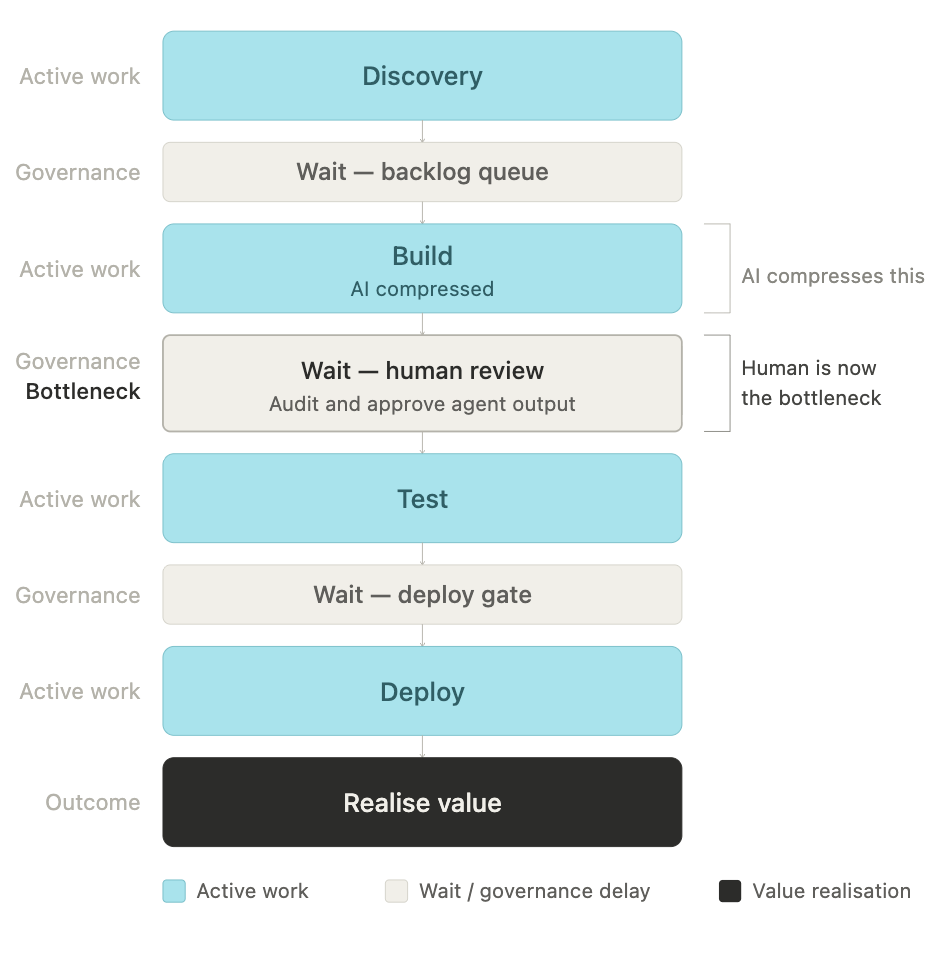
AI typically reduces delivery time. Without considering the full value stream, it rarely reduces wait time.
Core Measures
Flow Efficiency
Active time vs wait time across the delivery pipeline. Exposes governance bottlenecks and handoff delays. This includes Verification Latency. Increasingly the agent will not be the bottleneck, but the human will. Productivity is measured by how quickly a human can audit and approve an agents work.
End-to-End Cycle Time
Time from commitment to realised outcome.
Failure Fix Time
Time from identification of issue to resolution.
True acceleration occurs when constraints across the value stream are removed, not when isolated tasks are optimised.
4. Predictability
Can We Reliably Forecast Outcomes?
Acceleration without reliability increases volatility.
Core Measures
Work Completion vs Commitment
Ratio of work completed to work committed in each period. Measures whether the organisation finishes what it starts.
Target Completion Rate
Percentage of commitments delivered in any planning cycle.
Estimation Learning Rate
Trend in forecast accuracy over time.
Deployment Cadence Consistency
Regularity and stability of releases of change.
Predictability converts speed into trust.
5. Quality
Are We Building Things That Work?
AI-assisted work increases throughput. Without discipline, it can increase failure rates.
Core Measures
Change Failure Rate
Percentage of change causing incidents.
First Time Pass Rate
Leading indicator of clarity and engineering discipline.
Rework Rate
Capacity consumed fixing previously completed work.
AI Drift
Where the AI solves the problem but violates a business principle.
Oversight
Quality of oversight, spotting AI errors. Including detection accuracy and intervention timing (when to step in and how long this takes).
Technical and Process Debt Investment Ratio
Proportion of deliberate sustainability investment (healthy range: 15–20%).
High velocity combined with high rework
6. AI Risk & Governance Monitoring
Are we using AI Safely?
AI can significantly increase the risk exposure. We must continually measure this, especially when working in regulated environments and delivering services that can impact people’s lives. Whilst these are trailing indicators, it remains important to understand where failures have occurred.
Core Measures
AI Risk Incident Rate
Number of AI-driven decisions reversed or escalated
Bias, hallucination or compliance breaches
Model Drift Detection Time
Time from model degradation to intervention
Human Override Ratio
% of AI-assisted decisions requiring human correction
What Next?
Free Executive Alignment Briefing
Move from pilots to outcomes with a shared executive view.
To help leadership teams act with confidence, Mozaic is offering a free executive alignment session. This is a focused session for your board or ExCo to develop a common understanding of what AI adoption really means for your organisation: where value sits, the risks to manage, and the potential operating model changes required across functions, processes, governance, data, tooling, sourcing and people.
In this session we will…
- Clarify your strategic intent and risk appetite for AI
- Map key implications across Mozaic’s seven operating model dimensions
- Identify 3-5 priority focus areas and the preconditions for success.
You will receive…
- A one-page executive brief capturing agreed ambition and priority focus areas
- A simple readiness snapshot across the 7 Operating Model Dimensions
- A suggested next-steps pathway to inform deeper assessment, design, and business case work
With independent evidence showing most AI initiatives are failing to deliver returns, early alignment is the fastest way to avoid wasted spend and to target value safely and at pace.
Related Insights


Contact Us
Get in touch with our team to learn more about our services, explore partnership opportunities or discuss how we can help with your challenges.