

Summary
In today’s rapidly evolving business landscape, organisations across all sectors are grappling with how to best harness Generative AI (GenAI), automation, and other emerging technologies.
While these innovations hold immense potential for driving operational efficiency, opening new revenue streams, and enhancing customer engagement, many companies are leaping towards solutions in a piecemeal or ad-hoc fashion. Pressure from boards and executives to embrace the latest technology buzzwords can risk hasty adoption, without fully appreciating the strategic shifts required to realise the full value.
This top-down pressure can lead organisations to say, “Aye, AI Captain!“, and follow directives without a clear understanding of the broader business transformations and costs involved. Without a comprehensive strategy, businesses risk investing in tools that don’t align with their long-term goals, missing opportunities, and wasting valuable resources.
Mozaic’s proven 7 Dimensions of Strategic Advantage framework provides a structured, holistic approach that enables organisations to align these technologies with broader innovation portfolios and strategic intent.
Read on to discover how leveraging Mozaic’s Dimensions of Strategic Advantage can enable your company to be Future Ready in an era of constant technological disruption – capitalising on emerging opportunities, avoiding the pitfalls adoption, and positioning yourselves for long-term success.
7 Dimensions of Strategic Advantage
In a world of constant disruption, organisations need more than just a tactical approach to technology adoption—they need a framework that ensures every facet of their business is considered. Mozaic’s 7 Dimensions of Strategic Advantage are designed to provide exactly that. Tested across various industries, these dimensions have proven to be a comprehensive and reliable tool for aligning transformation initiatives with strategic goals.
Why The 7 Dimensions Work:
- Proven Methodology: The framework has been rigorously tested in multiple sectors, from legal to financial services, demonstrating its flexibility and adaptability.
- Comprehensive Coverage: Each dimension represents a key facet of business strategy and operations, ensuring that every initiative is approached from all relevant angles— whether it’s improving client engagement, enhancing operational efficiency, or managing risks.
- Tactical & Strategic Alignment: The dimensions provide a dual focus—offering both short-term tactical wins and long-term strategic advantage.
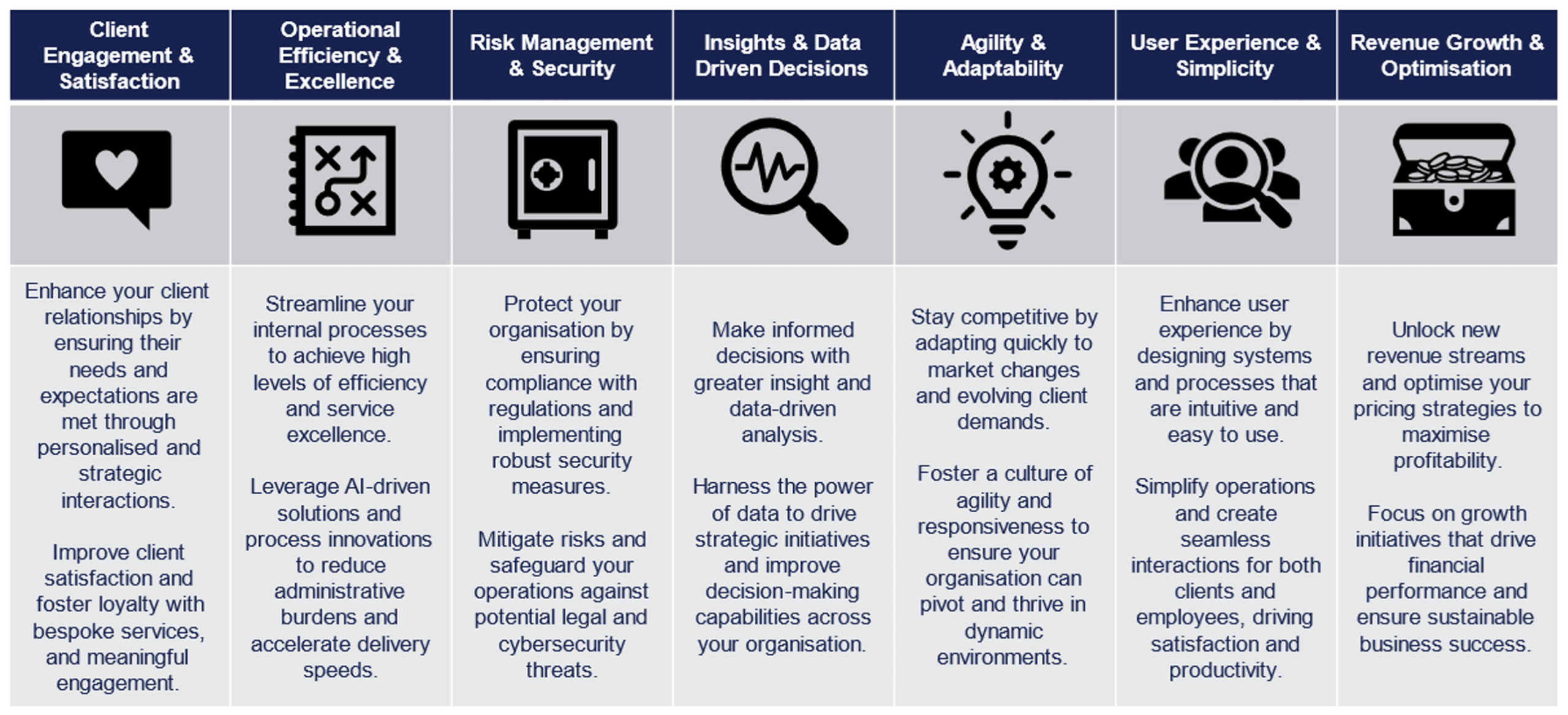
Each dimension ensures that all aspects of a successful business are addressed:
- Client Engagement & Satisfaction – Strong customer relationships are vital in today’s market. Personalised, seamless experiences foster loyalty and keep businesses competitive.
- Operational Efficiency & Excellence – Optimising processes through automation and AI reduces costs and boosts speed and accuracy.
- Risk Management & Security – With rising digital threats and regulations, robust risk management is essential. Focusing on security, compliance, and innovation safeguards data and prevents breaches.
- Insights & Data-Driven Decisions – Businesses generate vast data, but its value lies in actionable insights. Leveraging both qualitative and quantitative data guides strategic decisions.
- Agility & Adaptability – Adaptability to market shifts defines successful businesses. Flexibility in responding to market changes, customer needs, and regulations keeps organisations current and competitive.
- User Experience & Simplicity – Simplified, user-friendly systems ease adoption and reduce friction. Ensuring ease of use in new tools, for both employees and customers, promotes successful technological transitions.
- Revenue Growth & Optimisation – Innovation should drive profitability. This area focuses on unlocking and securing revenue streams, optimising pricing, and sustaining growth.
The Dimensions
The Changing Business Landscape: Adapting to AI & Innovation
Across industries, the rapid rise of GenAI, automation, and other emerging technologies is driving fundamental shifts in how businesses operate. These innovations hold the potential to revolutionise workflows, create new service offerings, and transform customer experiences. However, for many organisations, the adoption of these technologies remains patchy and disconnected from their overall business strategies.
Despite the promise of AI, fewer than 25% of companies report having successfully integrated AI into their operations on a large scale. While many businesses are conducting pilots or limited trials, few are able to fully scale these technologies across their enterprises or align them with broader strategic goals. Moreover, companies that rush into AI adoption without a clear roadmap risk missing out on the true value these tools can provide, wasting resources, or, worse, falling behind their competitors.
Key Challenges
As businesses across sectors attempt to harness the power of GenAI and automation, they encounter several common challenges that must be overcome to ensure successful integration and realisation of benefits:
- Top-Down Pressure Without Strategic Alignment: Many organisations adopt AI due to pressure from the board or external competitors, without a clear, long-term strategy. This often results in reactive, uncoordinated initiatives that don’t deliver meaningful results.
- Legacy Business Models and Structures: Traditional business models and outdated workflows limit the ability to adopt new technologies seamlessly. Companies still operating under rigid models often struggle to realise the full potential of AI due to their inability to pivot and adapt.
- High Costs and Resource Constraints: The initial investment required for AI technologies can be substantial, which, combined with tight budgets, makes it difficult for businesses to justify long-term benefits. 73% of companies report a critical lack of talent and skills to effectively implement AI.
- Technological Disruption and Integration Complexity: AI evolves rapidly, and many companies struggle to keep pace. 70% of organisations continue to rely on manual processes that could be automated, which hinders their ability to innovate and scale efficiently.
- Trust and Data Security: Building trust in AI solutions remains a significant hurdle. Concerns over data security, privacy, and transparency are common, with 41% of organisations citing trust issues as a critical barrier to adoption.
- Cultural Resistance: Internal resistance from employees or leadership can hinder the adoption of AI. Concerns over job displacement, workflow disruption, and loss of traditional work methods contribute to this resistance, slowing digital transformation.
- Training and User Adoption: The effectiveness of AI depends heavily on user adoption. Simplified interfaces, proper training programs, and a clear understanding of how AI fits into daily workflows are essential for successful integration.
Benefits
Organisations that overcome these challenges stand to gain significantly:
- Operational Efficiency: AI can automate repetitive tasks, freeing up employees to focus on more strategic work.
Early adopters have reported productivity increases of up to 80%, highlighting the efficiency gains possible with AI-driven workflows. - New Service Offerings: AI unlocks opportunities for new business models, allowing companies to offer innovative, data-driven services.
For example, AI-powered analytics have enabled businesses to create new, customer- focused services, driving significant revenue growth. - Enhanced Customer Engagement: Personalisation through AI improves customer satisfaction.
Companies using AI for customer experience management report a 6.7% increase in customer retention rates. - Proactive Risk Management: AI tools can help organisations mitigate risks by predicting potential issues before they escalate.
AI-powered compliance monitoring has reduced regulatory breaches by 40% in some sectors. - Data-Driven Decision Making: AI analytics allow businesses to make faster, more informed decisions.
Companies that leverage AI in decision-making processes report a 20% improvement in decision-making speed. - Agility And Adaptability: AI enables businesses to adapt quickly to changing market conditions.
For instance, AI tools have reduced time-to-market for new products by up to 35%.
Building The Portfolio
Successfully navigating these complexities requires more than isolated efforts; it demands cross-organisation buy-in and transformation.
This is where clear assessment and articulation of the necessary changes, effort, and value is vital to ensuring that AI & technology adoption is seamless and beneficial across all levels of the organisation.
Without the right strategy, organisations risk drifting aimlessly through the tides of technological change. By embracing a structured approach, businesses can chart their course toward innovation and ensure that AI adoption drives lasting success, not short-term fixes.
Mozaic’s 7 Dimensions of Strategic Advantage framework provides a holistic way to assess impacts, identify opportunities, and drive innovation through a quantified and prioritised portfolio of strategic and tactical activities. By offering this structured approach to adopting AI and other emerging technologies, the framework helps build innovation pipelines that ensure sustainable, long-term growth.
7 Dimensions of Strategic Advantage:
Framework Application
The 7 Dimensions of Strategic Advantage framework offers organisations a structured, practical approach to navigating the challenges of AI and innovation. By breaking down complex initiatives into manageable components, this framework helps companies ensure that innovation is not just a buzzword but a catalyst for real, sustainable transformation.
Whether your organisation is grappling with operational changes, understanding AI’s impact on workflows, or identifying new revenue opportunities, the framework’s flexibility ensures that each dimension is tailored to your specific goals and challenges.
Tailoring and Applying the Framework
Whilst our approach is customised for each client and their sector, focusing on the unique challenges and opportunities, the broad steps to be taken are:
Strategic Alignment
AI and innovation initiatives must be aligned with broader business objectives. The dimensions help you assess where technology can have the most strategic impact, such as by improving customer engagement, enhancing operational efficiency, or optimising revenue streams. In practical terms, this means translating high-level goals into actionable projects, ensuring every effort drives measurable business value.
Impact Assessment
Through structured workshops and cross-functional collaboration, the framework helps evaluate the full spectrum of AI’s impact. This can include operational changes, shifts in customer engagement, and new compliance challenges. By assessing the potential effects on each dimension, you can create a roadmap that addresses both opportunities and risks, ensuring comprehensive coverage across the business.
- Impact Definition: Define how AI and similar EmTech advancements might affect the organisation. A negative impact is seen as a threat, while a positive impact is viewed as an
- Example: If AI implementation will streamline customer service, what impact does that have on client satisfaction or operational workflows? Each dimension considers both the opportunities and challenges.
Prioritisation – Value And Feasibility
With numerous potential AI use cases, it’s essential to focus on those that offer the highest value and can be delivered feasibly. The dimensions provide a framework for prioritising initiatives and building a comprehensive portfolio based on strategic importance, complexity, and available resources. This ensures that innovation efforts are not spread too thin but targeted where they can deliver the greatest impact.
- Value & Effort: Value will, amongst other things, consider how closely an initiative aligns with the organisation’s strategic objectives (e.g. OKRs) and its potential to achieve those goals. Effort evaluates the resources, time, cost, and complexity required to implement the initiative.
- Prioritisation: Initiatives are prioritised using tools such as impact effort matrices and Mozaic’s proprietary weighting systems. This approach helps organisations focus on projects that deliver early wins while building capacity for long-term strategic projects.
Fostering Cross-Function Buy-In
Successful AI adoption requires collaboration across departments. The framework fosters this by encouraging input from all levels of the organisation—from leadership to operational teams. Engaging stakeholders throughout the process ensures that the technology isn’t just implemented, but fully integrated into the way the organisation operates.
- Engagement Method: Workshops, interviews, and stakeholder meetings encourage input from leadership and operational teams. This cross-functional collaboration ensures that AI and innovation are fully integrated into business processes, maximising adoption and long-term success.
Continuous Iteration
Innovation is not a one-time event. By embedding the dimensions into your organisation’s strategy, you create a system for continuous assessment and improvement. This framework allows organisations to evolve alongside technological advancements, ensuring that AI and other innovations continue to deliver value long after initial implementation.
- Product & User-Centred: A product-centric approach is highly recommended to focus on delivering value continuously through iterative development, ensuring that products & services are continually refined based on customer feedback and market Where organisational or operating model maturity is required to enable this, it should have been built into the holistic change portfolio through the refinement process.
- Iterative Monitoring: Performance data, stakeholder feedback, and market trends are continuously reviewed to inform improvements, keeping the organisation agile and adaptable to ongoing technological advancements.
Case Study: Supporting a Multinational Law Firm to Harness AI & Innovation
Background
A multinational organisation engaged Mozaic to assess the impacts and opportunities presented by GenAI and other emerging technologies. The objective was to enhance their innovation portfolio and ensure the business remained ‘Future Facing’ in its adoption and planning of solutions across various departments.
The Challenge
The organisation faced challenges in engaging its key departments, developing a detailed analysis, overcoming embedded traditional models, and addressing concerns and anxiety over the uncertainty that technology advancements might bring. Despite having a mature Innovation Function, their initiative pipeline needed strengthening and there was a fear they might be falling behind competitors. They required a comprehensive framework to identify opportunities, assess impacts, and prioritise initiatives across the firm, appreciating these would extend beyond technical solutions to challenge core business models and strategies.
The Approach
Initial Assessment:
- Conducted a series of workshops involving attendees from a full range of roles across the organisation, ensuring representation from leadership, operational teams, and front-line
- Gathered insights on current processes, pain points, and strategic goals to ensure alignment with the firm’s overarching objectives.
Framework Application:
- Applied the 7 Dimensions of Strategic Advantage framework to categorise hundreds of impacts and ideas generated during the workshops.
- Focused on impacts and opportunities related to Client Engagement, Operational Efficiency, Risk Management, Data-driven Decisions, Agility, User Experience, and Revenue Growth.
- Example impacts identified included softer, people implications relating to future lawyer skills and capabilities working alongside AI, and how through various initiatives, partner time could be freed up to increase client-facing interactions and business development activities.
Inclusive Collaboration:
- Facilitated sessions to encourage collaboration and foster a culture of innovation within the firm, ensuring buy-in from all parts of the business.
- Enabled cross-functional teams to develop a comprehensive picture of the opportunities and impacts of GenAI.
- To ensure all workshop participants were listened to and had their inputs captured, a mixture of individual and group activities were utilised.
- Impacts were captured individually, before being clustered via an ‘Affinity Mapping’ technique by all attendees leading to a shared understanding.
- For ideation, a ‘6-3-5 Brainwriting’ activity was utilised, allowing attendees to work in silence, before building on other participants’ ideas, followed by group discussion and voting.
Developing The Innovation Pipeline:
- Prioritised ideas based on feasibility and potential impact, using Mozaic’s proprietary weighting mechanisms.
- Created an innovation pipeline to manage the development and implementation of these ideas, ensuring continuous review and adaptation.
- Engaged a cross functional team to prioritise initiatives by further estimating impacts and efforts of each, and then applying scoring, weighing, ultimately plotting on a matrix and offering a robust audit trail.
- Impact was quantified through scoring as how much of a difference would be made to the organisation, with key weightings around urgency, volume of practice groups impacted, and alignment to strategic goals (e.g. growing revenue, gaining market share or internal time savings).
Key Insights and Outcomes
- Holistic Business Changes: The facilitated sessions resulted in a significant list of initiatives addressing business changes across all 7 dimensions of the framework.
- Enhanced Ownership And Engagement: The engagement increased thinking about and ownership of innovation agendas within each Business Unit, with teams becoming more proactive in identifying and driving relevant changes.
- Detailed Understanding: The organisation developed a detailed micro picture of how GenAI would impact various service area, enabling more informed decision-making and prioritisation of initiatives.
- The organisation knew more about which service areas were threatened by AI, whether via anticipated (new) competitors entering the market, competitors deploying solutions to reduce costs and/or solutions becoming readily available that enables clients to take work in-house. Higher prioritisation filters were applied based on proximity of these threats and ease by which they could be mitigated.
Next Steps
- Implementation Of Initiatives: Taking forward the prioritised initiatives with a clearer understanding of the holistic changes required to enable and enact them.
- Sustained Engagement: Ensuring continuous engagement and ownership within Practice Groups to drive ongoing innovation.
- Integration With Delivery Pipeline: Aligning initiatives with the firm’s product- orientation, ensuring that changes are driven by those involved in day-to-day work for better success and adoption.
Conclusion
By applying the 7 Dimensions of Strategic Advantage framework, the organisation was able to identify, evaluate, and prioritise a comprehensive portfolio of opportunities for AI adoption.
Though this case study focuses on a multinational organisation, these principles apply to any industry looking to modernise its operations and innovate. Whether you’re a global company or a regional player, the structured approach ensures that AI adoption can be scalable, strategic, and impactful across sectors.
Conclusion and Recommendations
Businesses across industries are facing an era of profound transformation driven by technologies like Generative AI (GenAI) and other emerging innovations. Many organisations are quick to say, “Aye, AI Captain”, when pressured to adopt such technologies, however, truly successful implementation requires more than following directives.
Strategic foresight, and a clear understanding of the broader transformation needed to deliver lasting value is required to fully capitalise on these, and can be hindered by fragmented decision-making, resource constraints, and a lack of cohesive strategy.
Mozaic’s 7 Dimensions of Strategic Advantage framework provides a structured, adaptable approach that helps organisations overcome these barriers. By aligning initiatives with business objectives, assessing impacts holistically, and fostering cross-functional collaboration, this framework empowers companies to turn innovation into sustainable, measurable results.
Whether it’s enhancing operational efficiency, fostering data-driven decision-making, or improving client engagement, the dimensions offer a clear roadmap for transformation that ensures companies remain agile, competitive, and future-ready.
Recommendations
To successfully leverage emerging technologies and achieve the desired outcomes, businesses should consider the following recommendations:
- Strategic Alignment: Ensure that AI adoption is not an isolated effort but is integrated across the organisation’s broader strategy. A top-down mandate without a clear roadmap risks misalignment and wasted investment.
- Customer-Centric Innovation: Engage customers and key stakeholders early in the process to understand their needs, ensuring that AI and other technologies improve interactions and overall satisfaction.
- Operational Efficiency: Conduct a detailed review of current workflows to identify areas where automation and AI can create the most value. Focus on implementing solutions that reduce manual tasks, freeing up teams for higher-value activities.
- Agility & Flexibility: Build an organisational culture that fosters agility. The ability to rapidly pivot and adapt to technological advancements is critical to staying ahead of competitors. Incorporate agile methodologies to drive continuous improvement.
- Data-Driven Decision-Making: Leverage AI and analytics to transform your decision- making processes. Use data to identify key trends, inform strategy, and enable real-time responses to market changes.
- Cross-Functional Collaboration: Encourage collaboration across departments to break down silos. True innovation happens when teams work together, leveraging diverse perspectives to solve complex problems.
- Comprehensive Training Programmes: Ensure that all employees receive relevant training and understand how new technologies will impact their roles. This helps drive adoption and ensures a smooth transition to AI-driven workflows.
- Enhanced Security & Compliance: Ensure that security protocols and data compliance measures are built into your technology adoption strategy from the start. Businesses must be vigilant in protecting sensitive data and maintaining regulatory compliance.
Call to Action
The time to act is now. Organisations that embrace AI and innovation with a structured, holistic approach will thrive in an era of rapid technological change.
Mozaic’s 7 Dimensions of Strategic Advantage framework offers the expertise and proven methodology to guide businesses through this transformation.
Partner with Mozaic to ensure your innovation strategy is not only aligned with your business goals but also delivers sustainable, long-term success.
Together, we can navigate the complexities of today’s innovation landscape, making you the AI Captain and ensuring your organisation is Future Ready.
Related Insights


Contact Us
Get in touch with our team to learn more about our services, explore partnership opportunities or discuss how we can help with your challenges.