

Enterprise Service Integration
The Service Operating System of the Agentic Age
Service management has quietly become how the modern organisation runs. Enterprise Service Integration (ESI) is Mozaic’s model for running it in the agentic age. A single service control plane that orchestrates work across every domain and lets AI resolve, fulfil or escalate within governed guardrails. It is the successor to SIAM, and the operating model that finally lets AI investment land.
The way anyone (employee, customer, citizen or supplier) asks for something, gets it resolved or moves work forward is no longer tucked inside each function. It has become the operating layer of the enterprise itself. And agentic AI, automation and orchestration are changing what that layer can do: work that once needed a person to log, route, chase and resolve it can increasingly be handled straight through.
Most organisations are meeting that moment the wrong way. Layering AI on top of ticket-driven, human-mediated processes designed for a different era, and expanding the scope of service management without rethinking how the work is done. The result is predictable: bigger service organisations, rising cost and slow progress. As long as the model stays ticket-driven, cost tracks demand and experience plateaus, however much is spent on AI.


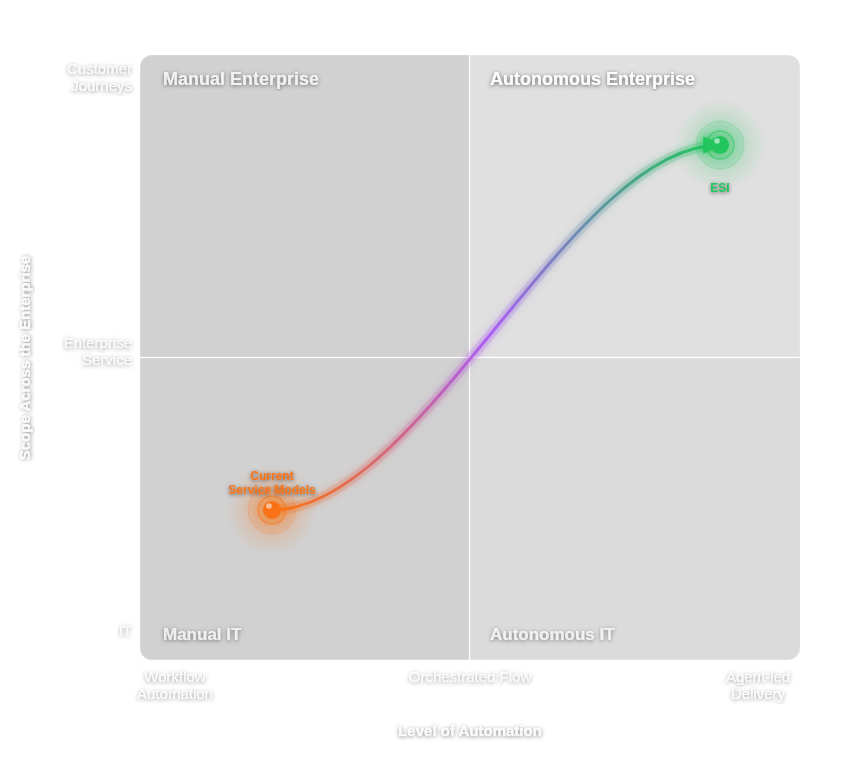
ESI Moves in Two Directions at Once
Move on only one axis and you fail. Extend service into more of the business while dragging the same manual mechanics, and you build a bigger, slower, more expensive version of the old problem. Use AI only to make people work faster, and you never redesign the work. ESI does both together.
From IT, to the Enterprise, to the Customer
Service extends beyond IT into HR, finance and facilities, then joins internal and customer-facing journeys into one coherent experience.
From Tickets, to Orchestration, to Agentic
Delivery moves from human coordination and ticket-driven workflows to automation and orchestration, and on to intent-driven execution where AI agents act within guardrails.
A Core, Surrounded by Four Integration Gateways
To make ESI buildable rather than aspirational, we have developed a structured reference architecture: five sections, 27 capability groups, 82 capabilities, a five-stage maturity model and 20 tooling categories. At its centre sits the Core, the service control plane. Around it, four Gateways connect service execution to the rest of the enterprise. Tooling is treated as a category, not a vendor decision, so the architecture stays portable and builds on the platforms you already run.
Connects user and customer experience to service execution: journeys, channels, intent capture and resolution.
Connects service to the technology estate so tools, platforms and data act together, not just pass tickets around.
Makes mixed internal and external delivery governable at scale, through shared patterns and management by exception.
Embeds risk, security, privacy, identity and AI assurance into the flow of work, enforced in real time.
Foundation to Fly
Every capability is described against five maturity levels, so you can baseline where you are today and target a coherent future state. Most enterprises sit at Foundation or Crawl; the value compounds at Run and Fly, where execution is integrated across systems and suppliers and the Core increasingly optimises itself within auditable guardrails.
The need for integration is recognised. Data and architecture exist in pockets; work is largely manual.
Priority services and workflows are mapped. Basic classification, routing and policy for selected use cases.
A common architecture, taxonomy, catalogue and rule set operate across the agreed scope.
Execution is integrated across systems, gateways and suppliers. Humans handle the exceptions.
The Core self-optimises. Agentic orchestration predicts demand and adapts policy within auditable guardrails.
A Lower Cost Base and a Better Experience
For organisations that combine consolidation, automation of high-volume demand and agentic execution, the operating model finally pays across every dimension that matters.
40%
>70%
Real-time
Scale stops requiring proportional cost. New services, suppliers and platforms onboard through integration and policy patterns that already exist.
Transformation in Practice


Transforming Service Integration at a National Healthcare Supply Organisation

Transforming Financial Services Delivery Through a Product-Oriented Model
First Step Towards ESI
ESI is adopted incrementally and is vendor-neutral by design. It builds on the platforms you already run. The concept is rarely the hard part; translating it into a practical, prioritised plan is. Our pro-bono workshop gives your leadership team a maturity baseline, a shared target model, priority opportunities and a high-level roadmap to begin.