

There's Gold in Those Data Centres!
Data in the 21st Century was like Oil in the 18th Century: an immensely, untapped valuable asset. Like oil, for those who see Data’s fundamental value and learn to extract and use it, there have been huge rewards, but what will these rewards look like in the future and are you ready to exploit the benefits?
As Web 3.0 makes gains and technologies such as blockchain mature, the internet will change, and businesses will have to evolve with it. Web 3.0 offers the promise of better security and brings transparency and accountability to the forefront but also aims to be fully decentralised, putting content creation in the hands of creators and not just platform owners. If it comes to pass, Web 3.0’s impact on business could be more transparency and a greater orientation to users and customers than with today’s web. Therefore, the way businesses connect to and employ users’ data will change, as will value creation and the way businesses make money.
This paper delves into the profound value of data, drawing parallels with historical resource shifts, and outlines a strategic blueprint for businesses to capitalise on its potential in navigating the future. To achieve this, a recalibration of traditional operating models is imperative, aligning them with the data-driven landscape.
The Data Revolution Unveiled
From an inconspicuous by-product, data has ascended to the status of a strategic asset. Its power to illuminate customer behaviour, optimise operations, and inspire innovation is profound. Yet, this potential hinges on a fundamental transformation of how organisations operate.
Inherent Challenges in Conventional Models
In the labyrinth of traditional organisational structures, data is imprisoned in silos, thwarting holistic integration. The urgency to pivot from this archaic framework emanates from sporadic data-driven practices, elusive real-time data access, and bottlenecks in data usability. The question of data ownership, the role of Chief Data Officers, and the untapped potential of ecosystems amplify this clarion call for transformation.
The urgency to transform operating models stems from several key factors:
- Data at the heart of every decision and process – sporadic data-driven approaches are applied, from predictive systems to AI-driven automation, throughout the organisation, leaving value on the table and creating Many business problems still get solved through traditional approaches, processing through hierarchy and linear processes, and take months or years to resolve.
- Real-time data – the movement of, and access to, real-time data is still an aspiration for many. Only a fraction of data from connected devices is ingested, processed, queried, and analysed in real-time due to the limits of legacy technology structures, the challenges of adopting more modern architectural elements, and the high computational demands of intensive, real-time processing jobs. Companies must choose between speed and computational intensity, which can delay more sophisticated analysis and inhibit the implementation of real-time use cases.
- Ready-to-use data – most usable data is still stored in large monolithic data warehouses and organised in a structured fashion using relational database tools. Data engineers often spend significant time manually exploring data sets, establishing relationships among them, and joining them together. Data is also transformed manually, refining data from its natural, unstructured state into a structured form using manual and bespoke processes that are time-consuming, not scalable, and error prone.
- Data as a Product – today’s data function, if one exists outside of IT, manages data using top-down standards, rules, and controls. Data ownership is ambiguous resulting in data sets being stored, sometimes in duplication, siloed, and often costly environments, making it difficult for users within an organisation (such as data scientists looking for data to build analytics models) to quickly find, access, and integrate the data they need.
- The role of the Chief Data Officer – Chief Data Officers (CDOs) and their teams are today considered by many Chief Financial Officers (CFOs) to be part of the traditional IT cost centre, responsible for developing and tracking compliance with policies, standards, and procedures to manage data and ensure its quality.
- Internal and external Ecosystems create exponential value – today data is often siloed, if not within an organisation but certainly between organisations. While data- sharing arrangements with external partners, competitors and ecosystems are uncommon and limited.
- Security, privacy, and resiliency – data security and privacy are often viewed as compliance issues, driven by nascent regulatory data-protection mandates and consumers beginning to realise how much of their information is collected and used. Data security and privacy protections are often either insufficient or ‘one size fits all’ rather than tailored to individual data sets. Providing employees with secure data access is a highly manual process, again, making it error-prone and lengthy. Manual data-resiliency processes make it difficult to recover data quickly and fully, creating risks for lengthy data outages that impact employee productivity.
Future-Ready – Manifesting The Data-Driven Future
A paradigm shift awaits—one where agile innovation supersedes traditional roadmaps, real-time insights become standard, and data is readily deployable. The data-driven culture empowers employees for more profound human domains, fostering innovation, and laying the groundwork for hitherto unattainable products.
- Data at the heart of every decision and process – rather than defaulting to solving problems by developing lengthy, sometimes multiyear, road maps, nearly all employees are empowered to ask how innovative data techniques could resolve challenges in hours, days or weeks. Employees will be free to focus on more ‘human’ domains, such as innovation, collaboration, and communication. The data-driven culture will foster continuous performance improvement building differentiated customer and employee experiences and in turn enabling the growth of sophisticated new products that aren’t viable today.
- Real time data – already vast networks of connected devices gather and transmit data and insights, often in real time, but this trend is set to increase exponentially as more ‘digital twins’ are created. The focus will be on dynamic technologies rather than large, monolithic, and static data warehouses. Even the most sophisticated advanced analytics will be reasonably available to all organisations as the cost of cloud computing continues to decline and more powerful “in-memory” data tools come online (for example, Redis, Memcached).
- Ready to use data – Data will be organised for greater flexibility. The ability to query and understand relationships between unstructured and semi-structured data more easily and faster, which accelerates the development of new AI-driven capabilities and the discovery of new relationships in the data to drive innovation, will be the new normal. Sophisticated simulations and what-if scenarios using traditional machine learning capabilities or more-advanced techniques such as reinforcement learning will be the norm.
- Data as a Service – data assets are organised and supported as services, regardless of whether they’re used by internal teams or external customers. Data is no longer owned and managed in silo’s, these data services have dedicated teams, or “squads,” aligned against them to embed data security, evolve data engineering (for example, to transform data or continuously integrate new sources of data), and implement self- service access and analytics tools.
- The role of the Chief Data Officer – we are already seeing this transition but in the future CDOs and their teams will function as a business unit with profit-and-loss responsibilities. The data team, in partnership with business teams, are responsible for ideating new ways to use data, developing a holistic enterprise data strategy (and embedding it as part of a business strategy), and incubating new sources of revenue by monetising data services and data sharing.
- Internal and external Ecosystems create exponential value – large, complex organisations use data-sharing platforms to facilitate collaboration on data-driven initiatives, both within and between organisations. Data-driven companies actively participate in a data economy that facilitates the pooling of data to create more valuable insights for all members.
- Security, privacy, and resiliency – organisational mindsets have fully shifted toward treating data privacy, ethics, and security as areas of required competency, driven by evolving regulatory expectations such as the General Data Protection Regulation (GDPR); increasing consumer awareness of their data rights; and the increasingly high stakes of security incidents. Automated, near-constant backup procedures ensure data resiliency; faster recovery procedures rapidly establish and recover the “last good copy” of data in real time rather than days or weeks, thus minimising risks when technological glitches occur.
With such differences between where organisations operate today and where we need to be in the future, there is no doubt there is still an imperative to transform for many organisations. The demand to harness data’s value prompts the reimagining of operating models. In this journey, customer-centricity, agility, and cross-functional unity are the beacons guiding the way.
Forging an Adaptive Operating Model
Evolving toward a product-oriented model, capable of swift adaptation, aligns with data’s dynamic essence. Navigating the transformation journey necessitates addressing pivotal queries—measurement of success, work shaping for optimal ROI, requisite skills and their nurturing, alignment of product teams with management, and effective tooling.
A product-oriented operating model is centred on teams delivering value for their customers, be those internal (in the context of enabling services) or external, whilst balancing the demands of the enterprise for strategic alignment (e.g., architecture), platform, security, service management and people excellence (allowing individuals to thrive and develop their careers).
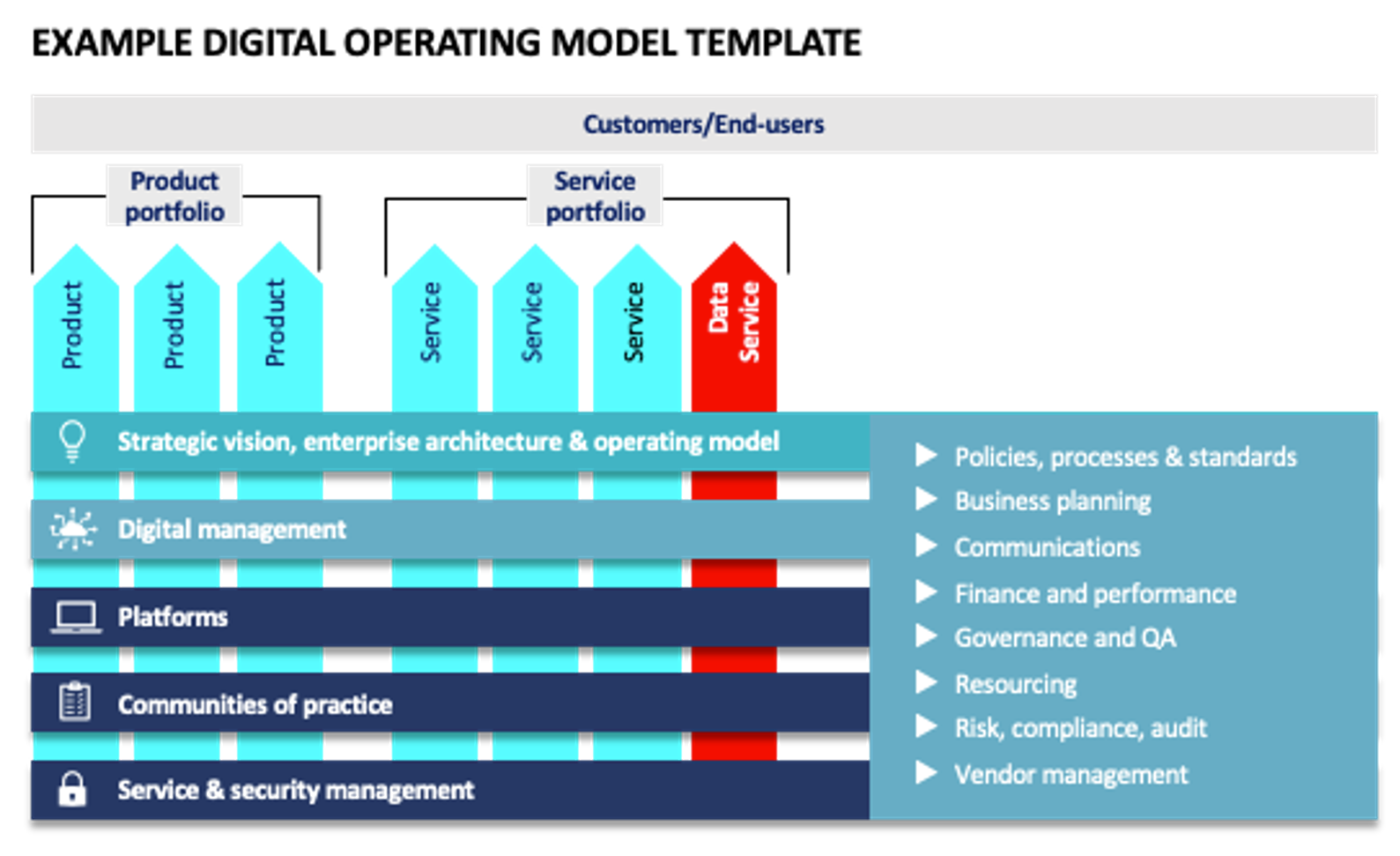
It is essential that any operating model is dynamic, and can adapt to ever-changing business needs, however, when transforming your enterprise to a product-oriented model, it is hugely beneficial to start from a tested, proven foundation.
Importantly, the model must address several key questions, including:
- How do you measure success?
- How do you shape the work to be delivered and maximise return on investment?
- What are the skills and attributes you need? How do you develop these?
- How do the product teams align with product management?
- How do the product teams integrate with organisational capabilities?
- What are the tooling enablers?
So where does data fit specifically? The simple answer is everywhere, in some form or other, but let us focus on the two critical components of the operating model that will help unleash the value from your data: data services and data platform. A data service is a reusable data asset designed to deliver value to data consumers that leverage it for a specific purpose. Ideally, data services can support multiple use cases, and serve any amount, and type, of authorised data consumers. It does not take away the need for data to also be implicit in other Products and Services but in those instances, the functionality of the product is the priority and not the data or it is consumption.
Data is also a Platform. Imagine a data platform that creates, manages, and delivers data services and relevant data to your products. What would it look like?
A Data Platform integrates, processes, and delivers datasets via products and services, with the aim of providing a fresh, complete view of relevant business entities (customers, orders, devices, claims, etc.) to anyone with the proper privileges.
It supplies the tools to manage the entire lifecycle of data services: from design and engineering to testing and deployment.
The data platform’s tools should encompass the following capabilities:
- Dynamic objects & links: Identify, collect, and harmonise data from disparate data sources and deliver it to any target system, via data products, in any delivery method: streaming, messaging, virtualisation, CDC, ETL, and API.
- Multi-modal properties: Generate object properties from models, structured data, streaming data, geospatial data, and any other data or model source. Configure model-derived properties for even richer semantic detail. Support data fabric, mesh, or hub architectures – in the cloud, on premises, or across hybrid environments.
- Preparation: Ingest, cleanse, transform, and enrich data in the platform, and then pipeline it to consuming applications and big data stores. Rapidly configure the properties behaviours, and interdependencies of common real-world concepts, such as scheduling, with pre-defined configuration patterns. High-fidelity objects can be set up in a matter of clicks, using low-code interfaces.
- AI-driven actions & functions: Represent the behaviour of your business in real-time kinetic graph, from actions made in transactional systems to those tied to models in industry specific tools. Link actions to semantic objects, forming the basis for AI-guided operations.
- Process mining & Automation: Mine actions and processes, reveal hidden action flows and inefficiencies, and quantify the business impact of changes. Monitor processes in real-time and bind models from your data to your processes for continuous optimisation.
- Orchestration: Execute actions across the system that run your enterprise in a stable, governed way by assigning writeback procedures to kinetic actions. Mediate changes to data and models in external environments, including across edge, tasking, and transactional systems for real-time business process workflows.
- Real-time monitoring: Empower non-technical teams to monitor your data quality. Low-code tooling makes it easy to author rules on objects, actions, and processes, including on objects with billions or trillions of streaming data points for real-time process monitoring and alerting.
- AI-guided decisions: Bind models to your objects and actions to guide decisions and automate processes. Models can reason across both the semantic and kinetic variables of your business, allowing them to compute globally optimal recommendations.
- Multi-step simulations: Create a live link between strategy and operations by simulating decisions across a range of metrics, such as profitability, production, or customer value. Simulations can be branched, chained across underlying models, and iterated on, allowing your teams to explore all possibilities in response to new events and changing conditions.
- Decision capture & learning: Capture decisions made within workflows and in response to simulations as new data, with complete lineage. Codify decision data back to AI/ML, closing the loop between operations and analytics and improving the predictive power of your simulations.
Want to know more about Product based Operating Models then read more of our White Papers here.
A Blueprint for Transformation and Overcoming Common Hurdles
The challenges in any transformational endeavour are tangible—cultural inertia, bridging skill gaps, respecting data ethics, and embracing technological integration. Mozaic’s Blueprint (below) for Transformation and experience in each of these areas lends perspective to surmount these roadblocks.
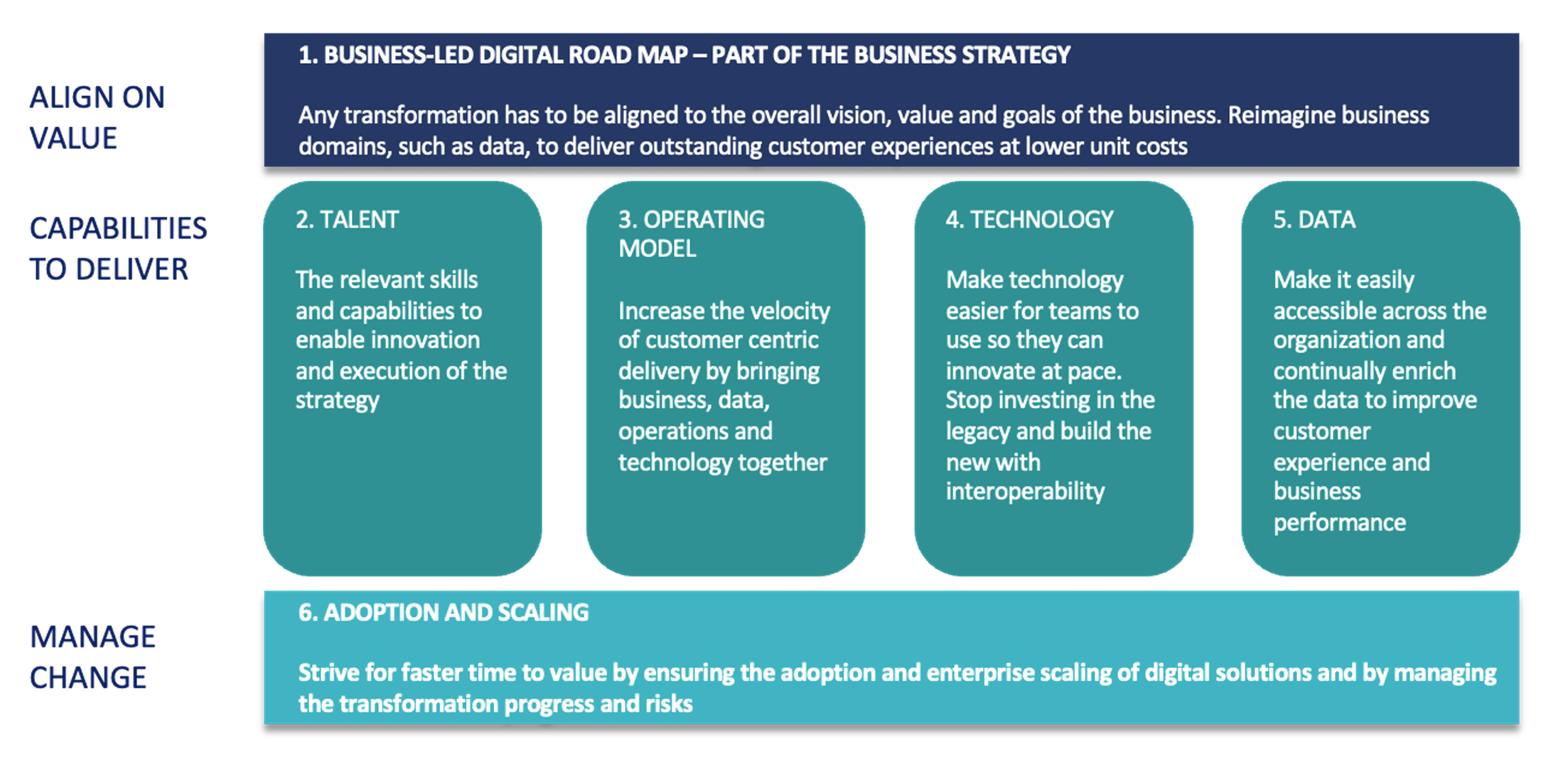
Guided by an unwavering (1) vision, roadmap creation, metric definition, and cohesive interdepartmental collaboration constitute the blueprint. Leadership’s commitment sets the tone, fortified by stringent data governance, skill augmentation initiatives, agile methodologies, and an unswerving focus on customers.
Next, develop the plans to assess and build the capabilities to deliver. (2) Identify skill gaps in your talent and invest in training and hiring initiatives. Develop a culture of continuous learning to keep pace with evolving data technologies. (3) Adopt agile methodologies across the entire operating model that encourage rapid experimentation, iteration, and quick adaptation. Cross-functional teams should collaborate to address challenges and seize opportunities. Place the customer at the centre of all operations. Utilise data to personalise experiences, optimise customer journeys, and anticipate evolving needs. Revise key performance indicators (KPIs) to align with data-driven goals. Measure success not only in terms of financial outcomes but also in terms of data utilisation, innovation, and customer satisfaction.
(4) In the digital crucible, a dynamic architecture emerges as the bedrock of a data-infused future. Flexibility, real-time processing, and cloud-native strategies hold the keys to unlocking data’s potential requiring the integration of advanced technologies such as AI, IoT, and cloud computing. Legacy systems may need to be upgraded or replaced to accommodate these technological shifts. Establish roadmaps to balance investment between legacy and future technologies with an emphasis on building relevant digital twins.
(5) Developing robust data governance policies to ensure data quality, security, and compliance are still imperative even in a culture that is more dynamic and empowering. Invest in scalable data infrastructures to support storage, processing, and analysis.
(6) Adoption and scaling isn’t a linear approach, at least not if you want to make progress and not be left behind in a theoretical strategy. While the previous 5 components form the blueprint for transformation Mozaic’s approach to adoption and scaling will help you overcome the common hurdles of change:
- Iterative delivery of high-value use cases – Mozaic’s strategy revolves around delivering tangible value in incremental stages. Showcasing success stories of high- value use cases validated by measurable outcomes. Data-backed validation of specific instances where data-driven decisions yielded exceptional results, influencing real- world outcomes. Set the vision and create the capabilities to deliver for a single use case, create the value and then iterate to scale.
- Deliver via product teams that understand the value of the data – Do not create another “Data” silo. Start with a collaborative approach that integrates data specialists into product teams, fostering a seamless connection between data insights and actionable strategies. Use these insights to form the cross-product requirements for future Data Products.
- Interoperability of new and old through technology integration and a standard ontology – do not be held back by heritage and legacy systems. Invest in the ontology that connects physical assets like plants, equipment, and products to concepts like customer orders or financial transactions. In many settings this approach to technology serves as the foundation to an organisation’s digital twin, enabling both the semantic elements and kinetic elements needed to achieve the use case value.
Mozaic’s approach to transformation challenges norms, delivering iterative value through data integration, collaboration, and a unified ontology. This unique methodology positions your organization for success in an evolving industry landscape.
Let Us Help Unleash Your Data’s Potential
The era of data-driven business has arrived, and operating models and technology architectures must evolve to accommodate this new reality. Organisations that embrace this transformation will unlock unprecedented value from their data assets, fostering innovation, improving customer experiences, and achieving sustainable growth, despite the technology. By addressing challenges head-on and adhering to a strategic framework, companies can position themselves at the forefront of the data revolution.
Not sure where to start or want to accelerate your transformation with a partner who has the skills and experience? We can quickly assess your current capabilities and help you to build and align your own transformation roadmap to your business’s vision, values, and goals.
Related Insights


Contact Us
Get in touch with our team to learn more about our services, explore partnership opportunities or discuss how we can help with your challenges.