

Executive Summary
As organisations pivot to value-streamed, product-led operating models, then traditional sourcing models, built for siloed functions, no longer work. Without redesigning how specialist, utility, and partnership services are sourced, organisations will unintentionally slow down their delivery and fail to capture the value of AI-driven productivity.
How Will Sourcing of Services Change?
In our previous papers in this series, we described how organisations are at a critical “tipping point” because of AI and other emerging technologies being introduced at scale. We have analysed how the operating models will move from functional delivery towards structures that are framed around the work that delivers value to their users – whether these be customers in commercial organisations or citizens within public sector.
To make these value streamed businesses safe, reliable and efficient, we also need to create (and assure use of) underpinning guardrails as well as patterning shared capabilities and platforms for reuse. Mozaic call this the Enterprise Product model.
This significant shift needs us also to re-shape and re-tension the services that we buy from third parties. This paper analyses these changes and recommends how to best change the sourcing strategy for the organisation of the future.
Why Does the Sourcing Strategy Need to Change to Support Enterprise Product Models?
Traditionally, contracts have been aligned to the functional structures of the organisation. Organisations have bought services such as an IT Service Desk or a Customer Contact Centre, Applications Maintenance and Support, Payroll or Facilities Management. Whilst many of the more commoditised services will remain as underpinning standard capabilities, we will need to restructure the more strategic delivery elements to align to the new Product/Value streamed delivery model.
To support this model, sourcing of some services must shift away from traditional, rigid, SLA-driven or cost-optimised approaches and instead enable rapid collaboration, adaptability, and value delivery. Product structures rely on multidisciplinary teams that can continuously refine priorities based on customer needs. Our sourcing models must no longer constrain flexibility or slow the ability to pivot. Whilst organisations often outsource to fill skill gaps, accelerate delivery, or reduce cost, the new structures will introduce a new challenges: contracts must allow teams to adapt quickly while still ensuring quality, expertise, and value for money.
While suppliers will rarely own the product management responsibilities or customer value decisions, aligning suppliers on leading indicators; quality, engineering excellence, and delivery cadence, helps create a shared focus on value even when direct value-based contracting isn’t fully achievable.
Ultimately, sourcing must become value-centric and trust-based, enabling the organisation and suppliers to collaborate as one team. Value-based sourcing models, supported by transparent metrics, shared accountability, and flexible commercial arrangements, are essential to allow Product or Value Streamed teams to move at market speed. Mutual trust becomes the enabler of “super-charged, collaborative relationships,” ensuring that third-party partnerships accelerate rather than hinder value delivery.
Alongside these structural changes, we expect suppliers to be using AI and other emerging technologies to deliver many of the tasks. This will deliver significant efficiencies and cost savings, and it is important that the new sourcing strategies create the right tensions between client and supplier to fairly share these benefits.
In the organisation of the future, client teams supported by their suppliers need to work in harmony, delivering value quickly, securely and cost effectively. The use of AI and other emerging technologies will happen across the ecosystem with benefits shared equitably.

How Should the Sourcing Strategy Change?
It is usual to consider the type of service in constructing the sourcing strategy. The sourcing portfolio view below creates a framework to understand how to best tension the pricing models to appropriately share benefits from the use of AI for each relationship:
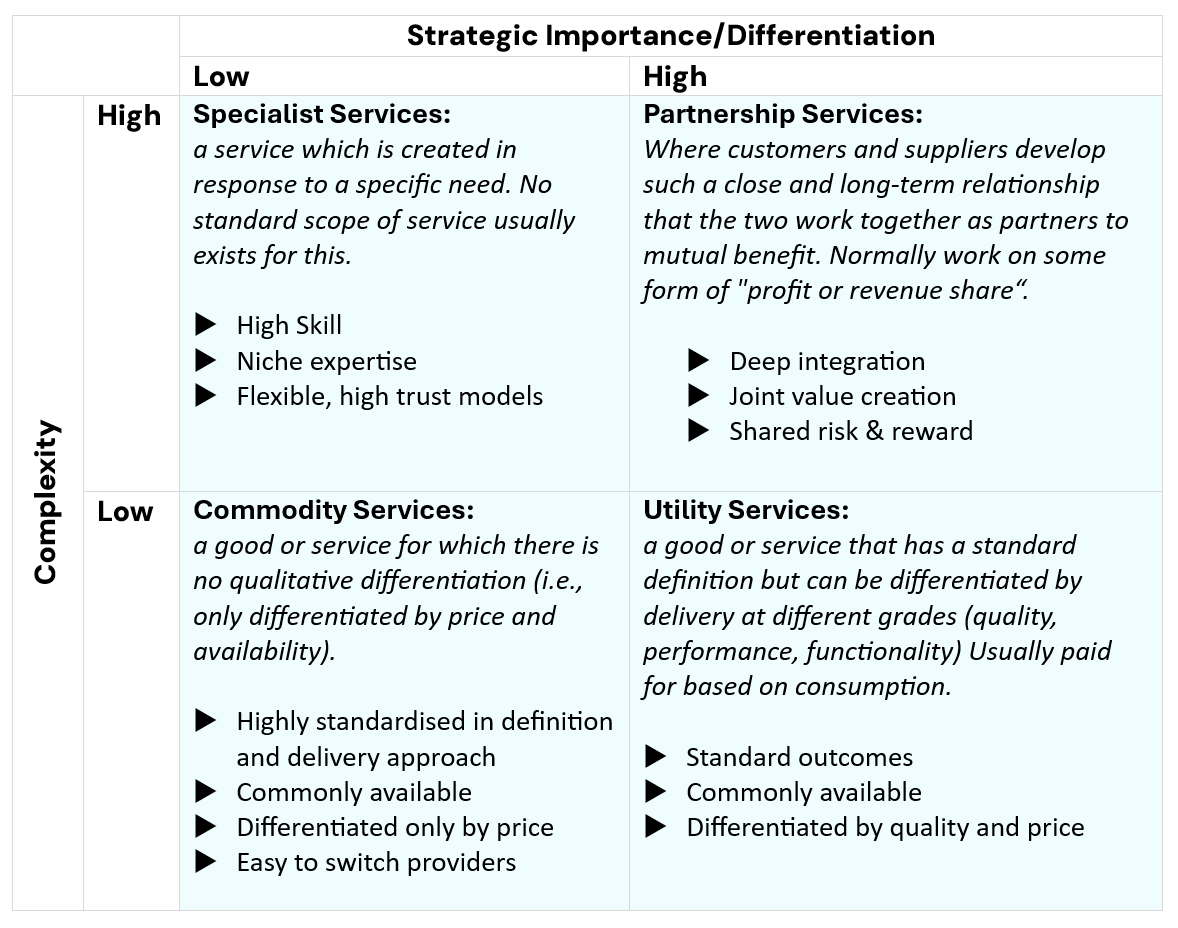
For each of these service types, we need to consider two things:
Do the services change as a result of organisations moving to more agile, value streamed based, operating models with greater use of AI in the client organisation?
- How do we provide the right tensions, through strong commercial service design and appropriate pricing mechanisms that drive best use of the emerging technologies such that there is a fair sharing of the benefits?
For the Commodity and Utility services:
- The market drives the standardisation, quality/performance and value for money, using traditional outcome-based service descriptions remains valid. There is therefore minimal requirement to reshape these service types.
- Allowing the supplier to determine how best to deliver these outcomes at a market competitive price naturally drives competition and is long proven to deliver effective and cost-effective solutions. However, with the ever-increasing speed of change, using benchmarking techniques alone to set price will set a lag in getting the best value. Benchmarking relies on historic data to set a best quartile or decile price point. To counter this we recommend that market comparison on what is expected to be achieved over coming years is also factored into the future pricing of services. Building utility style pricing models (where one pays for units of consumption) where the unit price reduces over time is not new, but is now more important. With the efficiencies that AI and other emerging technologies will delivery, service providers are offering significant reduction in unit costs over time. We have seen commitment of up to 70% reduction over 2 years for services traditionally reliant on large human teams.
Some examples of these types of services:
- Office supplies (Commodity): Priced per unit purchased. Simple to replace supplier with few dependencies or risks. Sourcing strategy would be to buy at best price at time of need through simple market competition (e.g. auction) with no long term commitment.
- Public Cloud (Highly Standardised Utility): Priced per unit where service and pricing model is highly standardised. Change is more difficult as implementation of specific cloud services have many technical inter-dependencies. Sourcing strategy is limited due to the high level of standardisation. However, making best use of volume discount mechanisms, with multi-sourcing providing competitive tensions and creating regular pricing reviews against market published rates. It is particularly important for these services to ensure that the client organisation has built solutions to manage consumption optimally – as examples, through strong FinOps processes and by reserving capacity and using automation to fill capacity requirements.
- Customer Contact Centre or Service Desk (Utility): Priced per unit by with contract being relatively unique to the customer. Change is difficult as service is fully integrated into the business. Best sourcing strategies here are to use outcome based service descriptions, pay per unit (where unit is a customer and not supplier driven metric) initially priced through competitive process and where supplier commits up front to regular unit price reduction in-line with market expectations and competitive process.
For Specialist Services:
- These services, by definition, are not standardised in the market. As we move to multi-disciplinary, product and platform teams defined around the business value streams, we need to reshape the service design to the specific needs of the organisation. The services also need alignment to the organisational guiderails, governance and ways of working that they deliver into. Agreement on the specific skills needed, and the responsibilities of the supplier within the model, need to be clearly articulated.
- These capabilities are typically more reliant on the niche expertise which has traditionally been available only through human delivery. However, AI usage is making the productivity of these skills much greater. We therefore must incentivise suppliers to deliver the productivity improvements. In simple resource augmentation models, there is incentive on suppliers to maintain (or even increase) the FTEs, so we need more sophistication to drive the best behaviours; what we want is to pay for the effort delivered whilst also ensuring that the expected productivity improvements are being achieved.
Some examples of ways of buying Specialist Services:
- Individual Expert Resources: The placement of individual specialists, including individuals from a third-party supplier to provide capacity where the work is managed by the client and delivery follows the client defined ways of working and tooling/systems. Individuals typically build client specific knowledge and can become important within the delivery model. The service design options for these services are relatively limited; agreeing best day rates and asking for innovation ideas and support. It is important to manage key risks around the reliance on individuals.
- Specialist Team and Capabilities: Teams of specialists from a single supplier to work in a specific domain e.g. User research, Regulatory Compliance or Data Scientists. In this model, the third party follows the defined guiderails and ways of working but have greater autonomy in the specific techniques and tools used to deliver their defined service. Services are described by the outcomes of their specialism rather than by individual role. Alongside value for money in the cost of the resources, sourcing strategies here should include contracting for productivity improvements with commitments that will (for the same volume of work) reduce the total price for the service over time. Productivity measurements should include metrics on focus (how the work delivered aligns to the roadmap), Speed (how quickly and for how much effort work is achieved), Predictability (reduced delivery risk and achievement on time) and Quality (process and outputs).
For Partnership Services
- Neither the service design or pricing models need change. There is already a natural alignment between customer and supplier (the Partners). For example, sharing profit means that the investments needed to embed emerging technologies in the delivery is shared alongside the benefits that this creates. However, the partnerships need deep and long-term relationships to be formed and can restrict the agility of an organisation to pivot. These relationships typically only work where the organisational strategy is defined and set for significant periods of time.
For example:
- Creating a revenue-sharing digital services partnership with joint IP development. In this model a Joint Venture may be created whereby costs, risks, and profit is fully shared.
Key Capabilities Needed to Make an AI Driven Model Work
We have explored the strategic control points needed within the retained organisation in our previous papers and will soon publish a new chapter to provide a more detailed description of the AI governance frameworks that need to be implemented.
In relation to the sourcing of services in the new world, we advise that our clients should retain several key capabilities within their organisation to maximise the benefits of the new sourcing strategy. These would include:
- AI and Emerging Technology market scanning; Identification and understanding of new emerging technologies (such as AI) and identification of possible use across their business to avoid vendor-led dependency and maintain strategic optionality
- Use Case development and prioritisation: The creation of Use Cases across the business, valuing the risk and opportunity for their implementation and creating a portfolio view to enable prioritisation and funding. This will ensure AI is aligned to business value, not technology exploration
- Delivery management: to ensure value is driven from AI Enablement in agreed Use Cases (where the use case is not fully within the remit of a third party)
- AI leadership and team coaching/training; Provision of training and coaching for use of AI across all levels of the organisation to support the business in identifying and accepting use of new and emerging technologies
- Exemplar Seed Teams, resourced with expert resource for highest value Use Cases to prove value quickly and build internal confidence
- Negotiation/contracting and subsequent management of supplier initiatives; Vendor management expertise to drive commitment and delivery of efficiencies into suppliers based on use of AI and other Emerging Technologies
- Measurement of the benefits delivered across the Portfolio of Opportunities: Maintenance of benefit tracking and reporting across all AI initiatives and Use Cases
What Next?
Free Executive Alignment Briefing
Move from pilots to outcomes with a shared executive view.
To help leadership teams act with confidence, Mozaic is offering a free executive alignment session. This is a focused session for your board or ExCo to develop a common understanding of what AI adoption really means for your organisation: where value sits, the risks to manage, and the potential operating model changes required across functions, processes, governance, data, tooling, sourcing and people.
In this session we will…
- Clarify your strategic intent and risk appetite for AI
- Map key implications across Mozaic’s seven operating model dimensions
- Identify 3-5 priority focus areas and the preconditions for success.
You will receive…
- A one-page executive brief capturing agreed ambition and priority focus areas
- A simple readiness snapshot across the 7 Operating Model Dimensions
- A suggested next-steps pathway to inform deeper assessment, design, and business case work
With independent evidence showing most AI initiatives are failing to deliver returns, early alignment is the fastest way to avoid wasted spend and to target value safely and at pace.
Related Insights


Contact Us
Get in touch with our team to learn more about our services, explore partnership opportunities or discuss how we can help with your challenges.