

SIAM Reinvented; Agile, Adaptive and Customer-Centric
Service Integration & Management (SIAM) is back, and it’s had a radical overhaul.
Tuned for the Agile and Product-centric operating models of today, this revitalised SIAM approach has the flexibility to integrate delivery from diverse capabilities – product teams, platform teams, managed service providers and IaaS/PaaS/SaaS providers. It’s focused on achieving customer outcomes and increasing value (rather than just optimising cost) and uses tooling, orchestration, data, and AI to optimise delivery and continuously improve the experience.
This paper delves into the key themes of this new SIAM approach, demonstrating how the core strengths of the model that was commonplace in complex technology and supplier ecosystems 10 years ago, have been infused with new approaches to supplier integration, data-driven operations, and workflow orchestration.
Background
Service Integration and Management (SIAM) is a concept that has existed for around 20 years, emerging from the UK Public Sector as a means of integrating IT service delivery from multiple suppliers. Through necessity, it was focused on pre-defined service requirements and procedural structures, expressed through contracts, to ensure that all suppliers followed a common approach to service delivery enabling individual ‘tower’ delivery to be integrated into end-to-end outcomes delivered to customers.
The dominant model was for an outsourced supplier to act as the SIAM, providing the Service Desk, tooling, service management and operational supplier management. Frustrations grew with the perceived inflexibility of this approach as onboarding new suppliers became costly and time-consuming, distance between the customer and the service towers led to poor supplier relationships and issues arose around the ownership of tooling and service data, making any change to the model costly and complex.
The response to this was for customers to take more control of this themselves by insourcing the integration activity owning the tooling platforms, defining their own processes, and controlling the data. We existed happily in this model for several years.
This status quo began to fracture when new delivery approaches such as DevOps and product-models became more commonplace and with the growing use of hyper-scale cloud services and SaaS platforms. The emergence of digital services and the Agile and Product- based models used to deliver them were incompatible with common SIAM models, with friction being felt in many areas. Change, Release, Transition etc were all areas where worlds collided. In addition to this, the emergence of commodity and subscription-based services added an additional complexity as the inflexibility of the prevalent SIAM commercial models made it very difficult to integrate these suppliers and services.
Many organisations moved away from multi-supplier models, either through consolidation or through the use of ‘prime’ suppliers. Others, particularly in central Government, insourced capabilities that would typically be better delivered by an outsourced partner using their scale and infrastructure. Whilst benefits were achieved through these changes, the fundamental issues that led to the original inception of SIAM began to reemerge. The size of in-house delivery and service integration teams has spiralled and getting valuable insight about integrated delivery has become highly complex.
So, What’s New?
In response to these new (but old) challenges, the underlying concepts and approaches of SIAM have been reviewed, refined, and reinvented. Many organisations are now embracing this new thinking and adopting SIAM approaches like that described in this paper.
Most organisations are aligning to a version of the Digital Service Management shown below. A key difference between this model and that prevalent 10 years ago is that all work is tuned to deliver value through Products and Services to the business. Please see our other whitepapers to explore the underpinning concepts of this model.
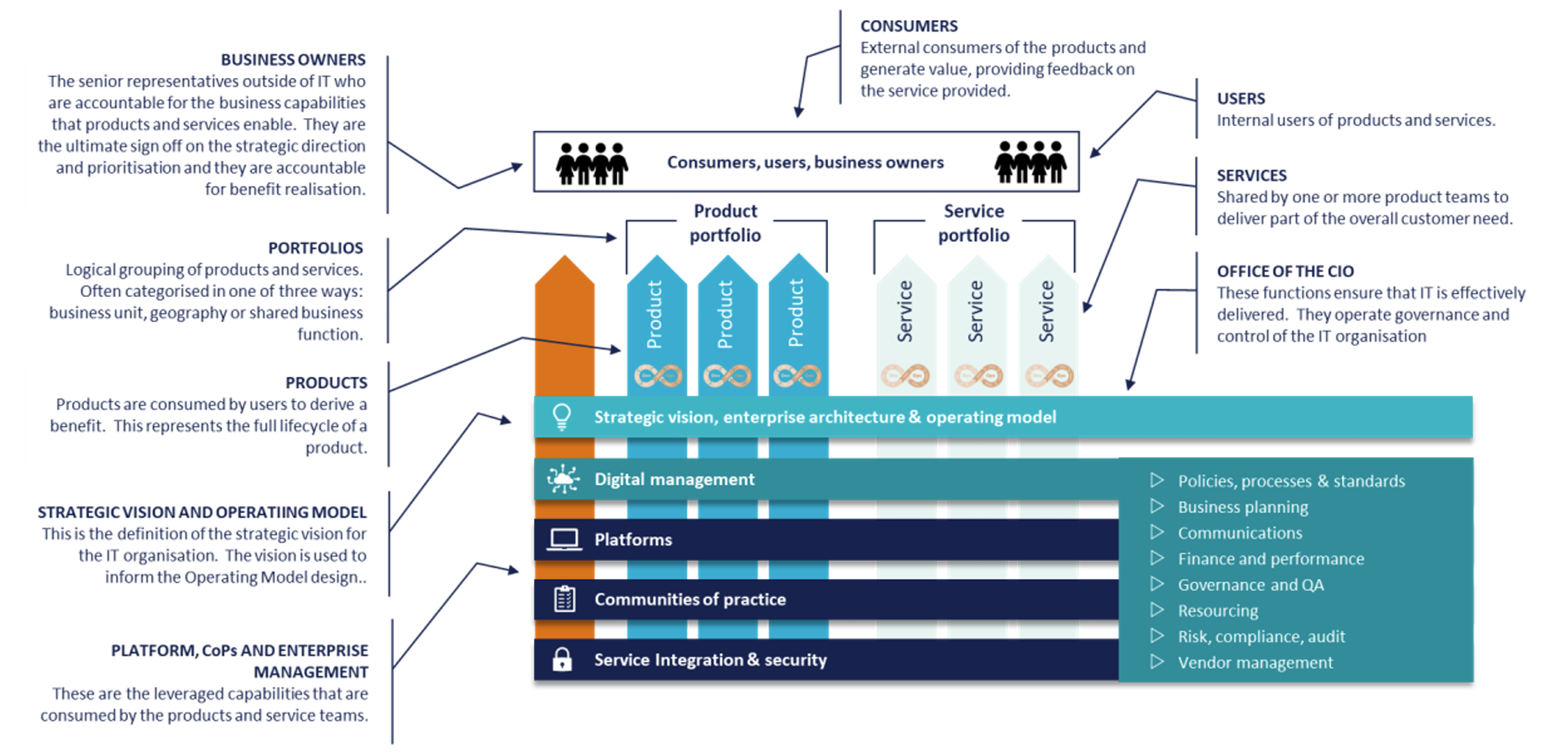
Effective SIAM delivery within a construct such as this requires refinements in several areas.
Focus – A common complaint about earlier SIAM models is that their focus was downward into the supply chain. There was an obsession with technical service KPIs and not enough focus on the business value being delivered. Enabled through improved service architectures such as the Common Services Data Model, and mechanisms to properly understand the experience and sentiment of service users, the focus of SIAM has shifted significantly to a more customer centric view.
Integrating service delivery and managing supplier relationships is still critical, but it’s now treated as a ‘means to an end’ to achieving excellence in customer service.
User communities are now included in service governance forums, reporting is real-time and based on customer experience, and the sentiment of users, measured through effective surveys and sentiment analysis, holds a top position in the hierarchy of measures.
Frictionless Delivery – Integration approaches for Product, Agile and DevOps teams have transformed massively in recent years. The velocity of change in these teams, and the ownership model of digital solutions was incompatible with old change management approaches.
The diagram below shows Mozaic’s Unified Model, which describes the typical end-to-end flow of work through technology delivery. No longer restricted to the ‘Operate’ space, a SIAM function needs to integrate and enable the frictionless flow of work across all stages of this model.

By analysing the workflows and creating effective integration between the core ITSM platform and the delivery management tools used by digital teams an effective SIAM capability can remove the friction caused by typical approaches to change, release, and transition. This approach delivers several benefits –
- Digital Product, Agile and DevOps teams can continue using their own tools, processes and language and are not forced to work on an alien ITSM platform.
- Automated approval of change, based on metrics and outcomes measured through the SDLC, means that the velocity of change is massively increased and the amount of effort involved is significantly reduced.
- The ITSM is populated with details of the change (or release) and the service catalogue, CMDB and knowledge base are updated automatically.
- A full audit trail of the change and associated approvals is maintained for audit and regulatory use.
- Most importantly, value is delivered to the end customers more quickly and frequently.
Data-Driven Operations – Leveraging the relationships and integrations created through Frictionless Delivery and incorporating the use of Machine Learning and AI Ops, service delivery is being transformed into predictive service optimisation capability. For example –
- Service issues are predicted based on service and event patterns, and resolved before they have an impact on users.
- Automated integrations that flow incidents and problems into the backlogs of digital teams mean that resolutions are worked on immediately, and updates are provided back to the ITSM tool, Service Desk and the user without needed intervention.
- Resilience can be triggered automatically.
- Post incident review is a data-driven activity. Customer impact can be measured, patterns in event data can be evaluated and underlying problems can be highlighted.
The diagram below shows a SIAM operations workflow that is driven by data and automation.
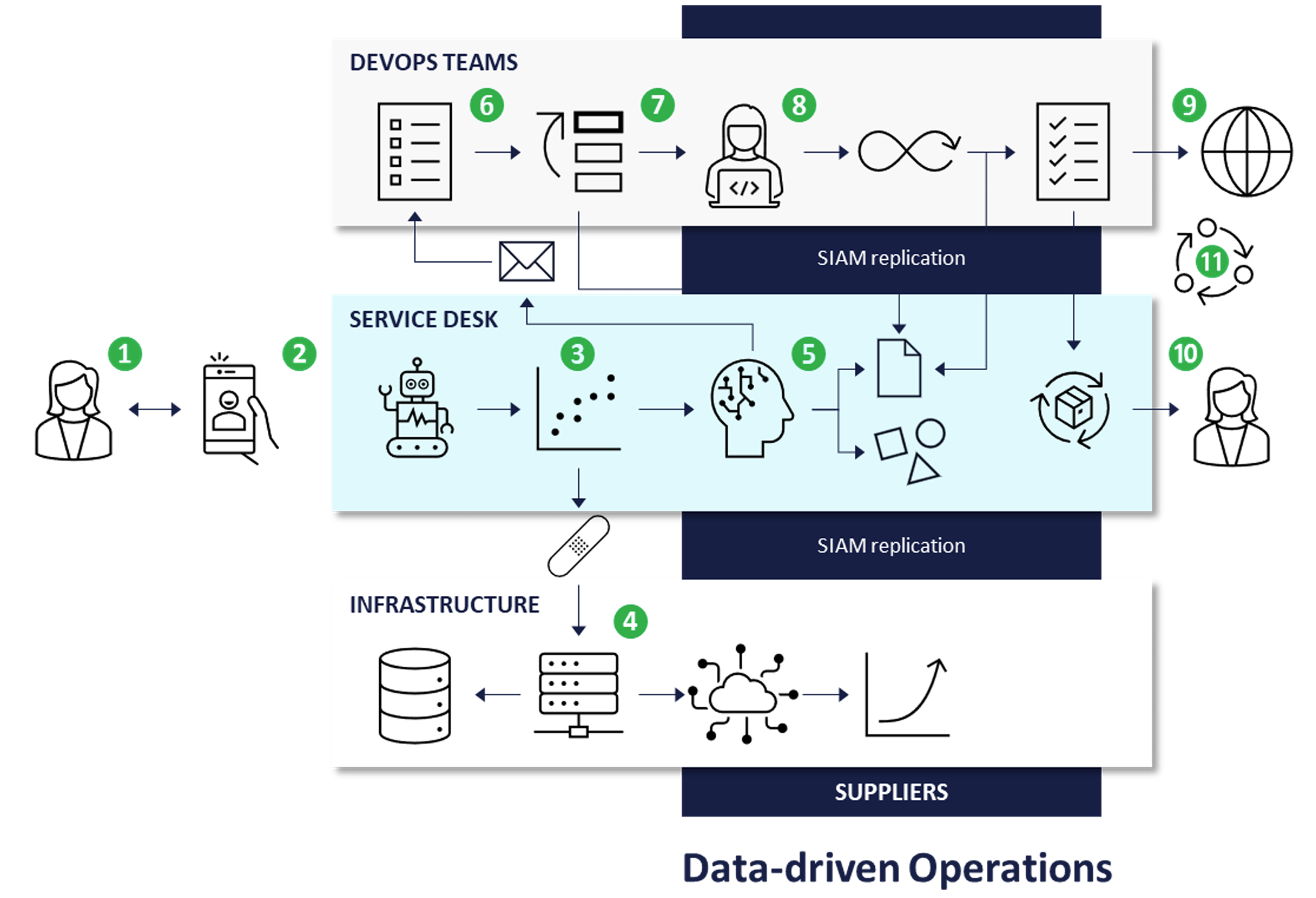
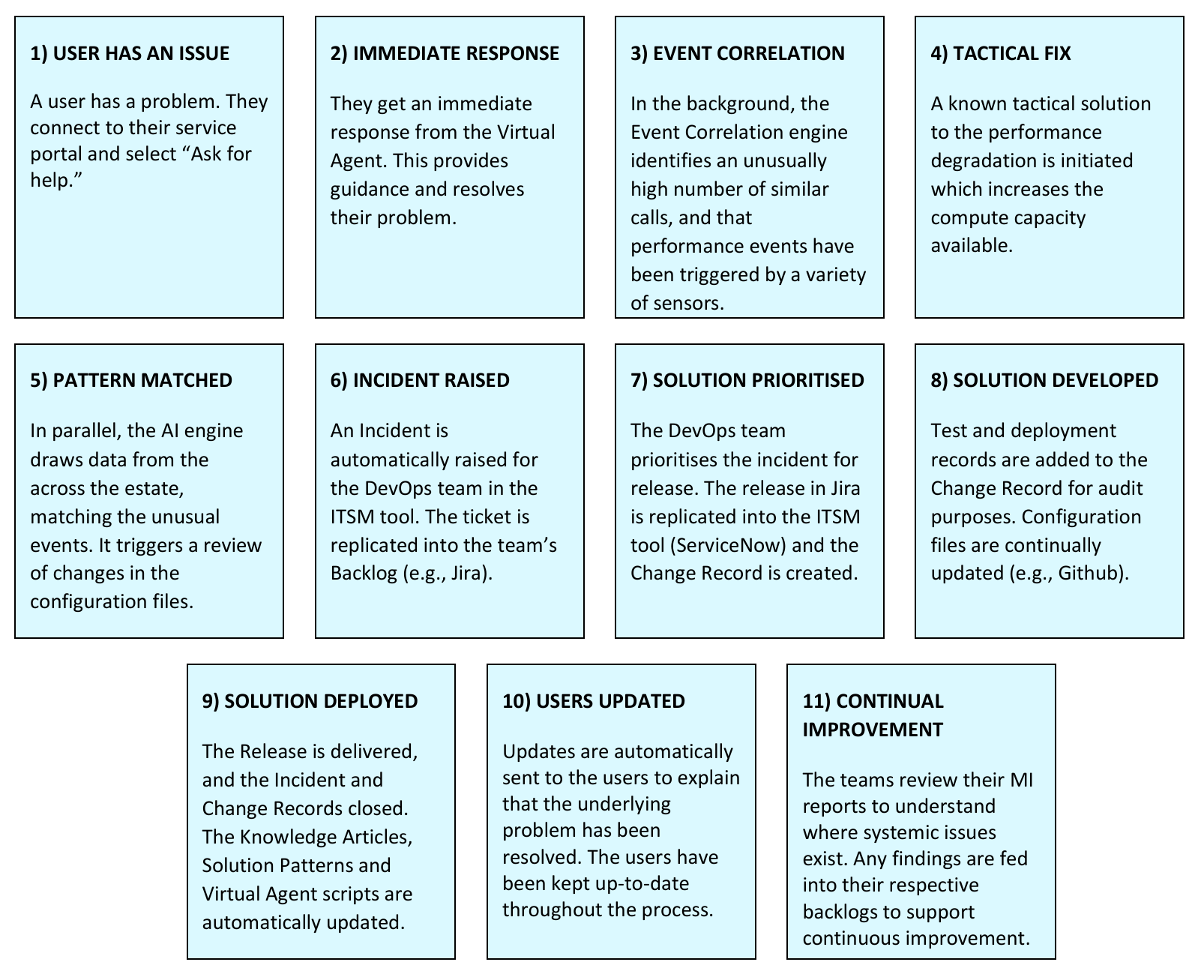
Data-driven operations is leading to the resolution of issues before they impact customers, faster diagnosis and correction and the ability to learn and respond in a much more structured and analytical way.
This level of analysis and orchestrated delivery has been the dream of Service Management professionals for the last decade, but it is now a reality. Most tier 1 ITSM toolsets already include the AI, machine learning and orchestration capabilities needed to achieve this. It relies on improving data quality and investing in professional design and implementation.
Supplier Integration – It is, and will always be, beneficial to ensure that suppliers are properly integrated into a SIAM model, with an appropriate commercial framework and way-of-working. However, the thinking on how to achieve this has shifted massively in recent years.
- Commodity cloud service providers are not going to sign up to a complex set of commercial agreements aligning their delivery to the SIAM model. They have their own Terms and Conditions, and their own ITSM solution. However, this is no longer a barrier to SIAM integration. Modern ITSM platforms have sophisticated integration models for all of the common cloud providers and the ability to develop APIs where a ready-made integration doesn’t exist. This ensures that incident, problem, change and request management tickets flow seamlessly between the SIAM and the commodity provider. Configuration and performance data can be captured directly from native platforms and used in processes with the SIAMs toolset. The management of cloud provisioning can now be effectively controlled through the ITSM platform and Service Portal, ensuring cost optimisation and alignment to enterprise architecture and security policies.
- Legacy SIAM models mirrored the supplier tiering system used by procurement and supplier management teams. The type of supplier integration was determined by the perceived strategic importance of the supplier and not the functional requirements of the services delivered by that supplier. This led to a number of issues including suppliers that were subjected to unnecessarily complicated and costly integrations and suppliers that were low in strategic impact but high in volume not being integrated at all.
Whilst it requires more upfront design and consideration of the configuration of the tooling platform, a flexible approach that can support the integration of suppliers based on the characteristics of the service delivered will deliver significant benefits. For example, a provider of mobile phone and broadband connections will benefit from effective integration for request fulfilment, but there’s little need for Event data to be shared.
Sourcing Approaches – Organisations are becoming more sophisticated in the operating model design of SIAM. A balance is being drawn between maintaining effective strategic control of service delivery and supplier relationships and making the most of the specialisms and scale of service providers. Key themes that are emerging here are:
- In most cases outsourcing the Service Desk remains the most cost effective solution. However, there is an increasing trend away from hyper-volume service providers that have ultra-low per-ticket costs, towards service providers that genuinely focus on optimising the customer experience and thinking more creatively about shifting left. A Service Desk that is genuinely trying to reduce its ‘failure demand’ to zero, and drive automation of all ‘value demand’ is the nirvana of Service Desks.
- Tooling, data and processes are, quite rightly, increasingly owned by customers. However, maintaining internal capabilities to manage tooling platforms is a recruitment and retention nightmare and many organisations a working with partners that can provide this as a service.
- Service management and operational supplier management are increasingly outsourced, but the delivery of these functions is organisationally integrated into in- house teams. It’s not uncommon to find the outsourced provider of a SIAM capability sitting on the leadership team of an IT function. It’s increasingly seen as a strategic partnering relationship, rather than a traditional service provider.
- Expertise in design and implementation is now being sought more often from specialist organisations. Properly designing and implementing the interplay between commercial structures, tooling, processes and organisations, and taking account of the needs of a modern SIAM, as described above, requires expertise and specialism.
So, What Should I Do?
The good news is that the shift from a ‘legacy’ SIAM approach to a refined and reinvented model can be achieved through focussed leadership and some straightforward structural and technical changes. If you work in an organisation that falls into any of the three states below, you should be critically examining your approach in several areas.
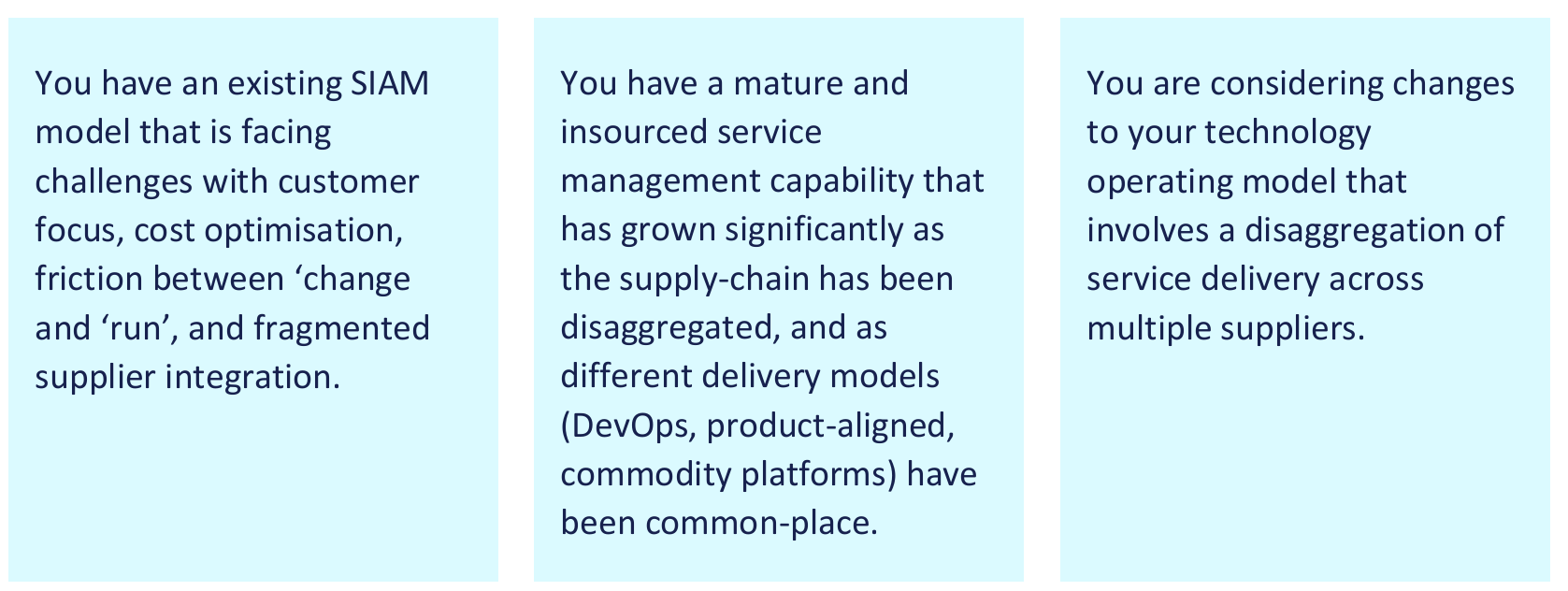
You should look carefully at:
- The approach to supplier integration, ensures that your tooling enables a flexible integration model that focuses more on the functional profile of the service that the supplier is providing.
- Aligning the service improvement with the tooling configuration. Enabling the SIAM drive change in tooling configuration will dramatically accelerate service improvement. The governance around this should be carefully designed to ensure that the tooling remains aligned with architecture standards and that the customer retains ownership of the configuration, processes and data.
- In addition to the usual set of operational metrics and SLAs, ensure that your Service Integration function is configured to gather the necessary real-time data required to demonstrate the value that is being delivered. Read our white paper titled Bridging Business & IT: Unified Value Measurement to understand how to measure IT value using the equation [INSERT FORMULA]
- The scope of your Service Integrator, whether it’s in or outsourced, ensures that it can influence, measure and improve delivery across the technology value stream. Significant value can be achieved through the optimisation of workflows in and out of service delivery. Business engagement is focused and value driven, design is optimised for delivery, delivery has a higher velocity and supplier relationships are rewarding for all concerned. Don’t make the mistake that the SIAM should only be about the ‘run’ part of the value chain.
- A balanced view of cost and value. Yes, implementing a data-driven operations capability will require investment, but the value generated through increased productivity and change velocity will dwarf the cost.
- An iterative and staged approach to design and implementation. It can sometimes be challenging to quantify all of the benefits of a SIAM approach upfront, so consider the sequencing carefully. Invest in the strategy and operating model design, and establish a sequenced roadmap of change. Build a high-level business case that demonstrates the ‘size-of-the-prize’ and seek investment for some proof of concept initiative. For example, explore opportunities for disaggregation and tooling transformation, and use the evidence and value created in these early initiatives to gain consensus and funding for further change. The important point is to have a ‘North Star’ that you are aiming for, so don’t skip on the early visioning, strategy and operating model development.
If you’re grappling with a legacy SIAM model that is struggling to meet the needs of a modern business, looking to drive more strategic IT investments, or exploring ways to enhance operational efficiency, we encourage you to get in touch.
Related Insights


Contact Us
Get in touch with our team to learn more about our services, explore partnership opportunities or discuss how we can help with your challenges.