

Cloud for Digital Excellence
It is common for vendors to sell the cloud as a platform that will reduce the total cost of ownership (TCO) and drive efficiency in IT technical and programme delivery, or as a quick route to the adoption of new technologies.
However, if the cloud is positioned solely as a technology platform the buyer is at risk of disappointment or outright failure (often due to a strategy of trialling the cloud for low – value products, and as a result not gaining the budgets needed to do it properly). When cloud is used for isolated business opportunities you can gain initial success but then run into significant headwinds when attempting to operate and scale new solutions.
Instead, you must think of the cloud as enabling new, adaptable, operating models which can accelerate digital excellence across your business. Achieving this will enable you to address the business and technology benefits of the cloud. Adaptability is key; considering how the cloud can help you build the capabilities you need to continually improve. Improvement should target excellence in product and service verticals across the enterprise.
In this paper, we will discuss eight areas where the cloud can help you strengthen your operating model capabilities and accelerate your digital excellence.
Cloud Capabilities to Accelerate Your Digital Excellence
Modern digital businesses are under constant pressure to change as customer expectations are evolving at an ever-increasing pace. Old project-based delivery approaches are not responsive compared to those used in modern digital businesses that are highly reactive to customer and market change.
To be successful you need to build capabilities that strengthen how you operate and adapt to ongoing change. Consider each new business priority as an opportunity to deliver results and simultaneously improve the capabilities of your operating model. Pick up the pace by continually harvesting learnings to mature your capabilities and ensure that each new business priority is delivered with less effort than the last.
Consider the following cloud capabilities as key enablers of this continual evolution:
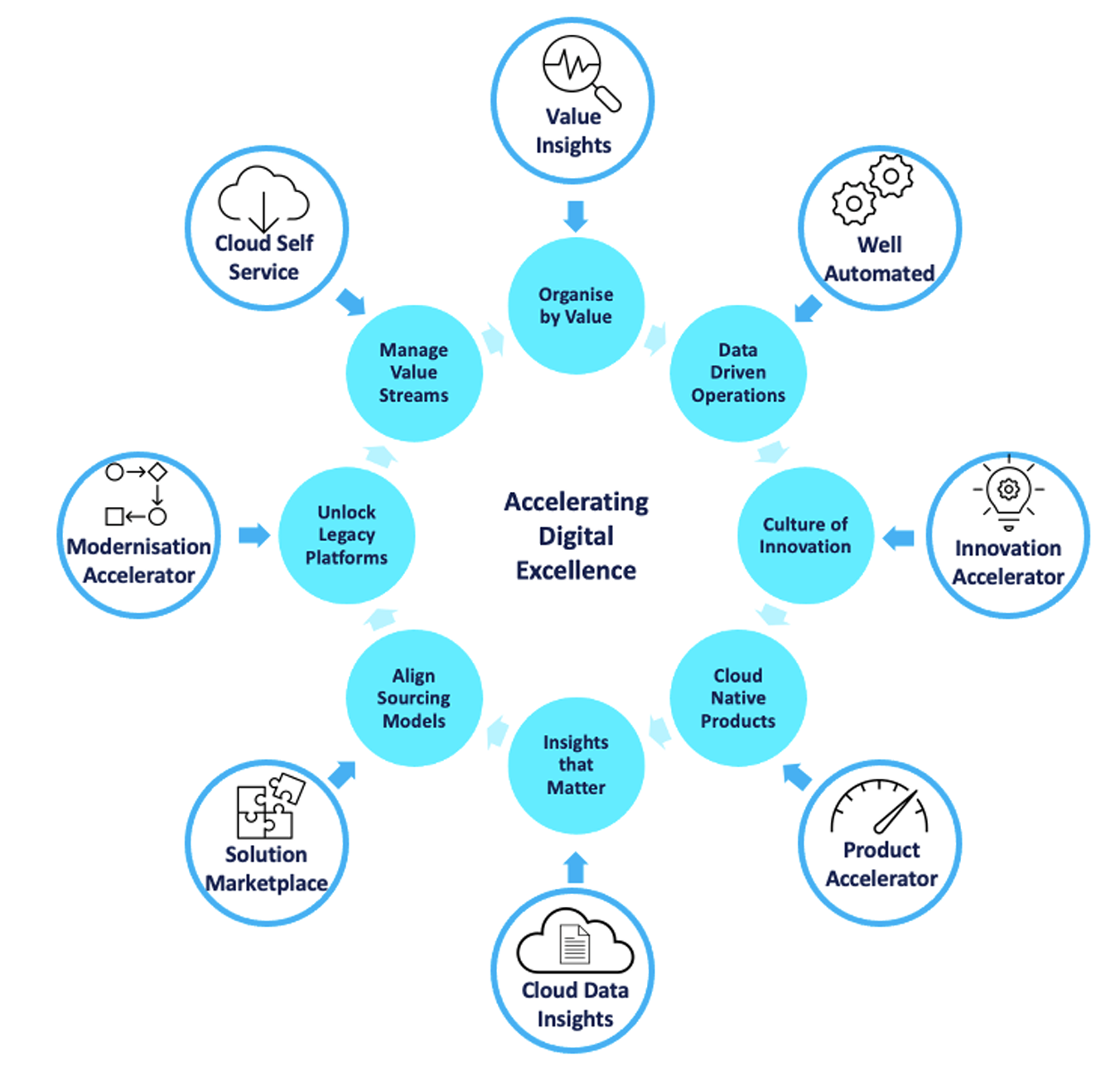
- Value Insights: Organise by value and shape work and how you deliver it with real – time insights.
- Well Automated: Close the loop on service delivery with data-driven automation within your products, services, and platforms on the cloud.
- Innovation Accelerator: Empower product-led teams to innovate on the cloud utilising self-service to get customer feedback quickly.
- Product Accelerator: Take full advantage of modern technology to deliver differentiated products that are designed to leverage cloud services.
- Cloud Data Insights: Unlock the value of data on the cloud to drive optimal products and optimal delivery.
- Solution Marketplace: Ensure alignment, and automation of third-party software and services to enable your teams to build to differentiate and buy the rest.
- Modernisation Accelerator: Build flexibility into your platforms on the cloud to unlock business logic and data to underpin innovation.
- Cloud Self-Service: Stop throttling change and enable your product and service teams to quickly build and deliver value quickly on the cloud.
An Enterprise Product Model is Key
The enterprise product operating model supports product and service teams with an enterprise-wide approach. This model is considered the industry best practice to enable teams to deliver what their customers want at pace with higher ROI while enabling enterprise teams to deliver at scale with efficiency and associated TCO benefits.
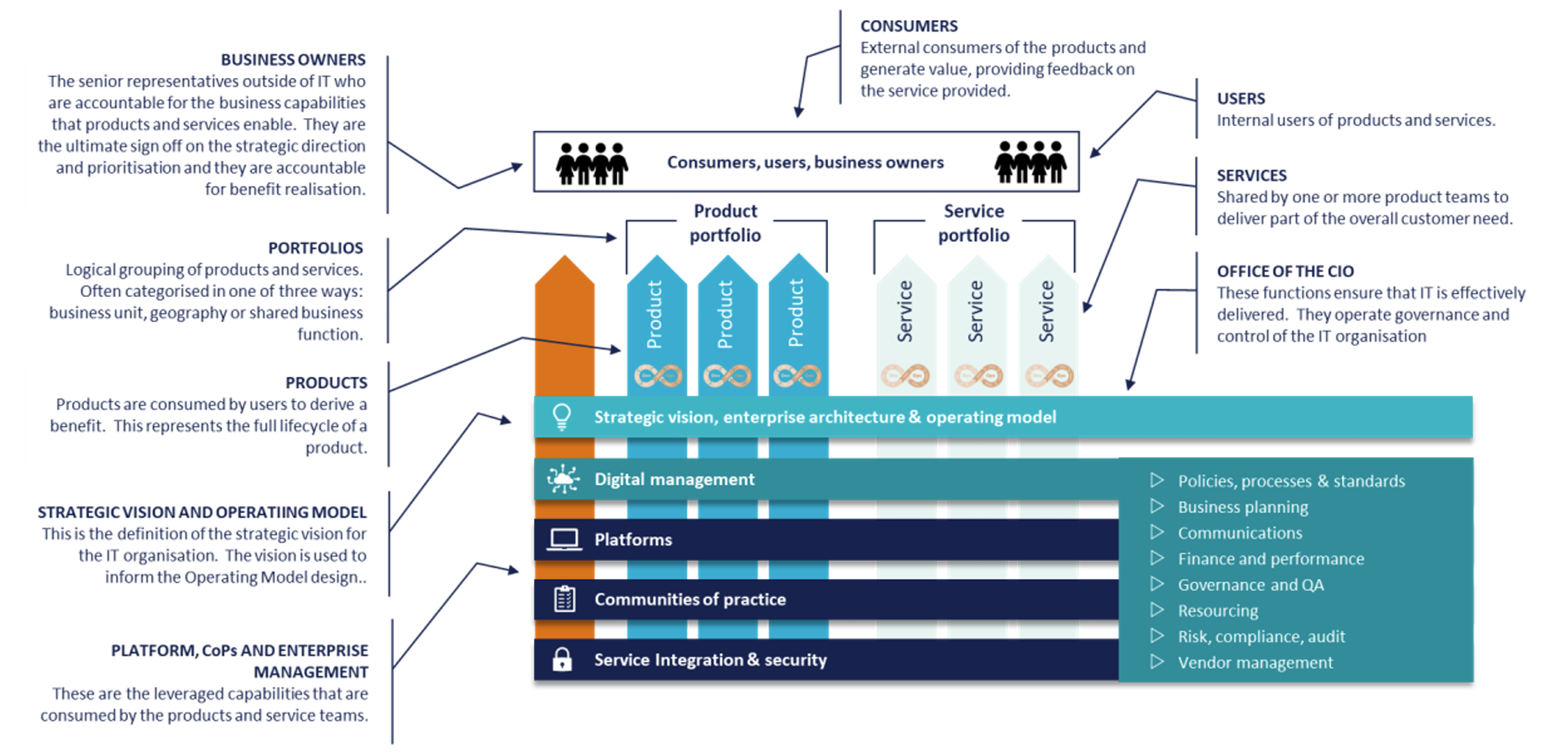
With success, this model should generate revenue upside in addition to cost efficiency to maximise profitability. However, while the benefits are compelling, caution is needed on the approach you take to operating model change. Focus on achieving business priorities and take each opportunity to improve the operating model with a clear vision of the capabilities and enablement you need. Have a long-term vision but deliver iterative change in short delivery cycles.
Focus on the Value of the Cloud
When considering the benefits of the cloud, focus on the value that should be realised against each layer of your operating model.
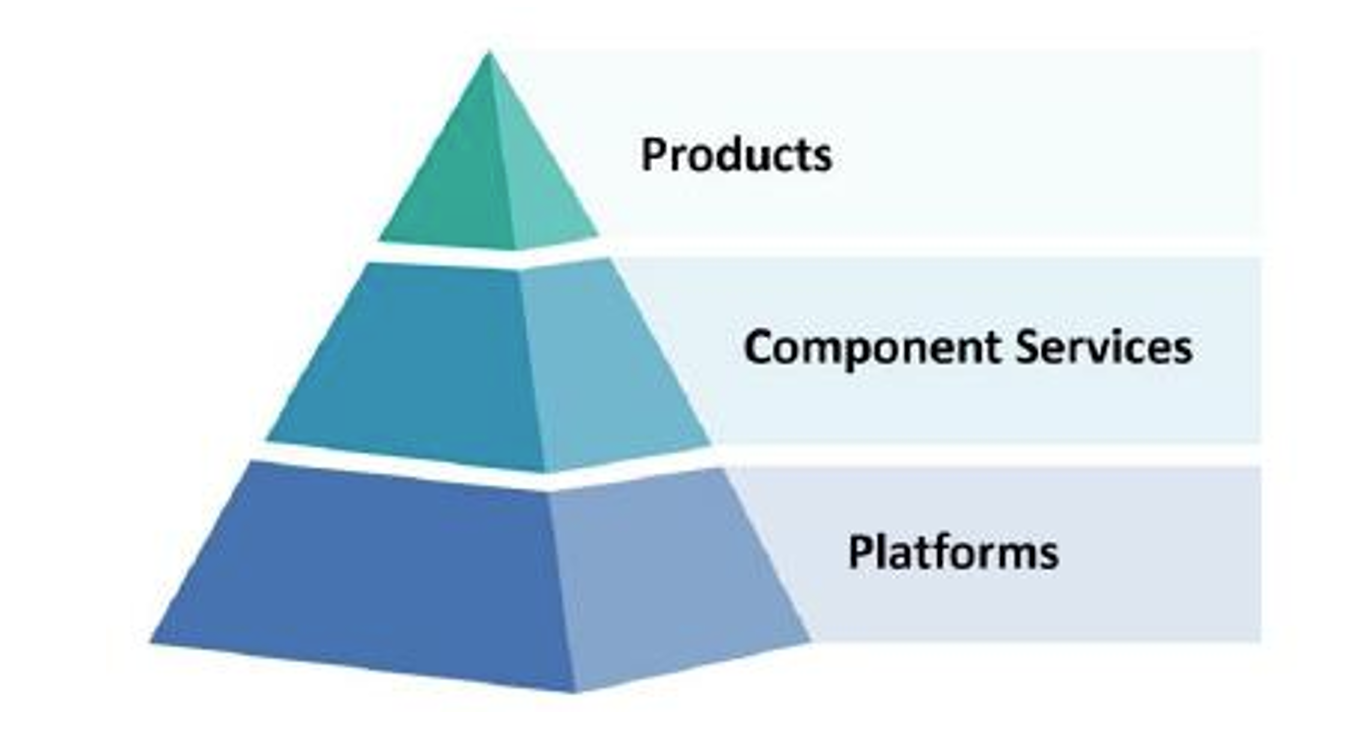
- Products are the high-value differentiators that set you apart from your competitors and need to be delivered quickly, reliably, and efficiently. Use the cloud to help your product led teams accelerate innovation and build cloud native products that are designed to take advantage of all the cloud has to offer with automation best practices built in. Enable value insights to drive product value management, prioritisation of investments and trigger changes to the operating model as product teams adapt to meet new customer needs.
- Component Services are underpinning applications that are shared across your business. Use the cloud to modernise and decouple application shared services to unlock business logic, data, and agility. Buy services where you can, invest in the reuse of the application code you own and automate for cloud delivery at the source. Build integration services to avoid innovation delays while you modernise platforms.
- Platforms include the cloud platform foundations that allow you to operate The platform underpins competitive advantage to your product and service teams so enable cloud self-service to help them work at pace. Provide reusable cloud delivery patterns with infrastructure as code to reduce effort and technical debt. Transition your portfolio to a commodity where it makes sense so you can focus budgets and investments higher in the value pyramid.
Enable Your Cloud Capabilities
The visual offers a signpost to the eight cloud capabilities and how they align with digital excellence.
Value Insights
An adaptable operating model should be driven by data with ownership of change distributed to product, service, and platform managers. Those leaders need to show the value they are delivering for the budget they need and to continually improve.
Value Insights depends on consistent ways to track budgets and investments against the measures and vectors that show the results. By doing this the cloud can help your data to be visualised, analysed and patterns can be detected with the help of artificial intelligence. These insights are then made available to aid strategic and operational planning that will benefit from a real-time view of performance against strategy.
The goal of value insights is to optimise investment in the right places of your portfolio and where needed adapt the products, services, and platforms you need. These insights include how your operating model achieves customer experience and revenue growth balances with efficiency and reducing operating costs.
Well Automated
Cloud providers enable you to automate what you buy from them, and this provides a valuable opportunity to drive efficiency into what you build and operate on the cloud. It is also a dependency to enjoy some of the cloud benefits that are not easily achieved in your data centres such as scaling services up and down to meet demand.
Cloud providers also offer services that can mature the way your products and services work together. Adapting API first strategies helps teams decouple to achieve an autonomous way of working and as a result, evolve products and services without delays. The promise of the cloud should provide developers with the tools they need to minimise the software they need to develop; this includes cloud-based artificial intelligence developer tools.
The cloud may not provide all the operational tools that your teams need, and this results in an integration point with your preferred operational and service management tooling. This integration point is also a target for automation to remove friction across digital service management. The well automated goal in the cloud should be to achieve automated provisioning, autoscaling and self-healing with built-in operating assumptions that anything can fail.
Innovation Accelerator
Innovation success depends on a relentless and long-term approach to understanding and then delivering what your customers want. Product led teams embrace lean and agile practices including ownership of the development and operation of the product (DevOps). Unfortunately, most organisations have culture and related processes that hinder innovation, and these must be eroded to support a culture of innovation and experimentation and enable teams to fail fast and learn.
The cloud should lessen the burden on teams needing a business case for investment that forces them to make assumptions and encourages them to be rigid in delivering what they thought was needed (but turned out to be wrong). Providing development teams with cloud self-service enables them to experiment quickly. The cloud can also allow teams to control access to these environments to support collaboration across teams and with consumer testing groups for early feedback.
The cloud should also help teams to innovate more quickly by taking advantage of the cloud provider services and the broad range of Independent Software Vendors (ISVs) and Open Innovation opportunities. By focusing on customer differentiation teams should design what they need to build and look to buy/integrate what they can. Making a solutions marketplace available to innovation teams will help them with build vs. buy decisions aligned to your enterprise strategy.
Product Accelerator
Cloud native products are built with modern software architectures that take advantage of the services the cloud can offer. Cloud native products typically consume cloud services and optimally will not directly depend on infrastructure at all (either physically or in the cloud).
Some products may need to evolve as they move from server-based computing to serverless event driven architectures. Teams need to make the right choices aligned to the availability of cloud platform services including managed containers, serverless compute and a broad range of data related services. Foundational artificial intelligence platforms are also an emerging dependency.
Where teams do depend on infrastructure, they should consume it as code. This allows them to focus on value while taking advantage of enterprise standards that define the patterns and automation that they can build on in the cloud. Related cloud tools such as API gateways are important to help teams integrate with legacy platforms without waiting for large scale modernisation.
Cloud Data Insights
Unlocking the value of their data is a competitive advantage for well-established enterprises but is often a very challenging topic for enterprise IT. Cloud at a platform level has services that can integrate with and democratise access to data. Cloud can also enable product and component service teams to unlock data and surface the value to be consumed.
Data Insights should be viewed as a product in the same way you might consider a product team that builds an application. Exploiting the underlying platforms and providing Analytics, Insights or AI via APIs can directly support customer value and in turn the efficient delivery of that value.
Data Insights also help underpin data-driven best practices across digital service management and by democratising access to the data you can also take advantage of Artificial Intelligence. As with all the cloud enablers the operating model dependencies are key to aligning security, controls and risk management to provide the required access to data in the cloud.
Solution Marketplace
Think of the solution marketplace as curated, standardised, and automated software assets that teams can easily consume and know that they are ready to deploy on the cloud. Standards offer you the opportunity to invest in automation at the point of origin and minimise the amount of technical debt that finds its way into your environment as new things are provisioned.
The marketplace should include supported software from independent software vendors along with any component services and code that your teams build and maintain. It may also provide linkage to approved software as a service (SaaS) with enterprise guidance on integration and end to end service management.
The goal of the marketplace is to accelerate innovation by building only what you need to, reusing existing investments, and buying what you don’t have.
Modernisation Accelerator
Unlocking the business logic and data from monolithic platforms is a common challenge for enterprises. The complexity, cost, and time to modernise these legacy platform can be significant – a problem for Innovation teams who can’t afford to wait.
The cloud offers opportunities to simplify the modernisation by taking a value led approach and iteratively re-platforming or re-architecting large monolithic platforms. The goal is often to pass the associated business logic and data to the ownership of product and micro service teams who then own the evolution of the business value.
The strangler pattern is a well-established approach to iteratively modernising large platforms and the cloud can help with gateways that redirect certain APIs as that underlying code cuts across to the cloud.
Other modernisation treatments include reprovisioning on the cloud or repurchasing as SaaS. For some applications, the treatment can simply be rehosting the existing server to the cloud, which will deliver limited modernisation but can deliver quick routes to value for improved Disaster Recovery, monitoring, and leveraging cloud tools to help product and services teams integrate with the application.
Cloud Self Service
Speed matters to product and service teams and waiting for access to resources in the cloud would limit one of the cloud’s key selling points. Cloud self service offers an approach for enterprise IT to delegate the ability for teams to consume the cloud while enabling essential controls, operational standards, and integration to service management.
Cloud self-service should include landing zone provisioning and a service catalogue to align access to the right cloud tools and services to the right teams. This enabler affords an opportunity to embed orchestration and automation at the source to minimise technical debt as new services are provisioned in the cloud. This also bottoms out the shared responsibility models between your teams and the services provided by the cloud provider.
In addition to the service on offer from the cloud provider, the catalogue may also link to internal assets such as the solution marketplace and associated code libraries that can help teams set up what they need with minimal effort and maximum standardisation. For DevOps team the landing zone provisioning can extend to cloud native pipeline tools and separation of environments to align with operational controls.
How Cloud Supports Business Priorities
You should consider three main areas where the cloud can help deliver your business priorities. [1] Cloud for new business opportunities; [2] Cloud to modernise your portfolio and [3] Cloud to accelerate your digital excellence.
[1] Cloud For New Business Opportunities
New business opportunities should start with how best to differentiate and meet the needs of your customer rather than being limited by the status quo. This should embrace business opportunities in a digital context for your industry such as E-commerce, Mobile Applications, Supply Chain, Digital Twin, Fintech, IOT, Big Data, Analytics, Customer Facing Content Management Systems, Gaming, Collaboration and Media Streaming.
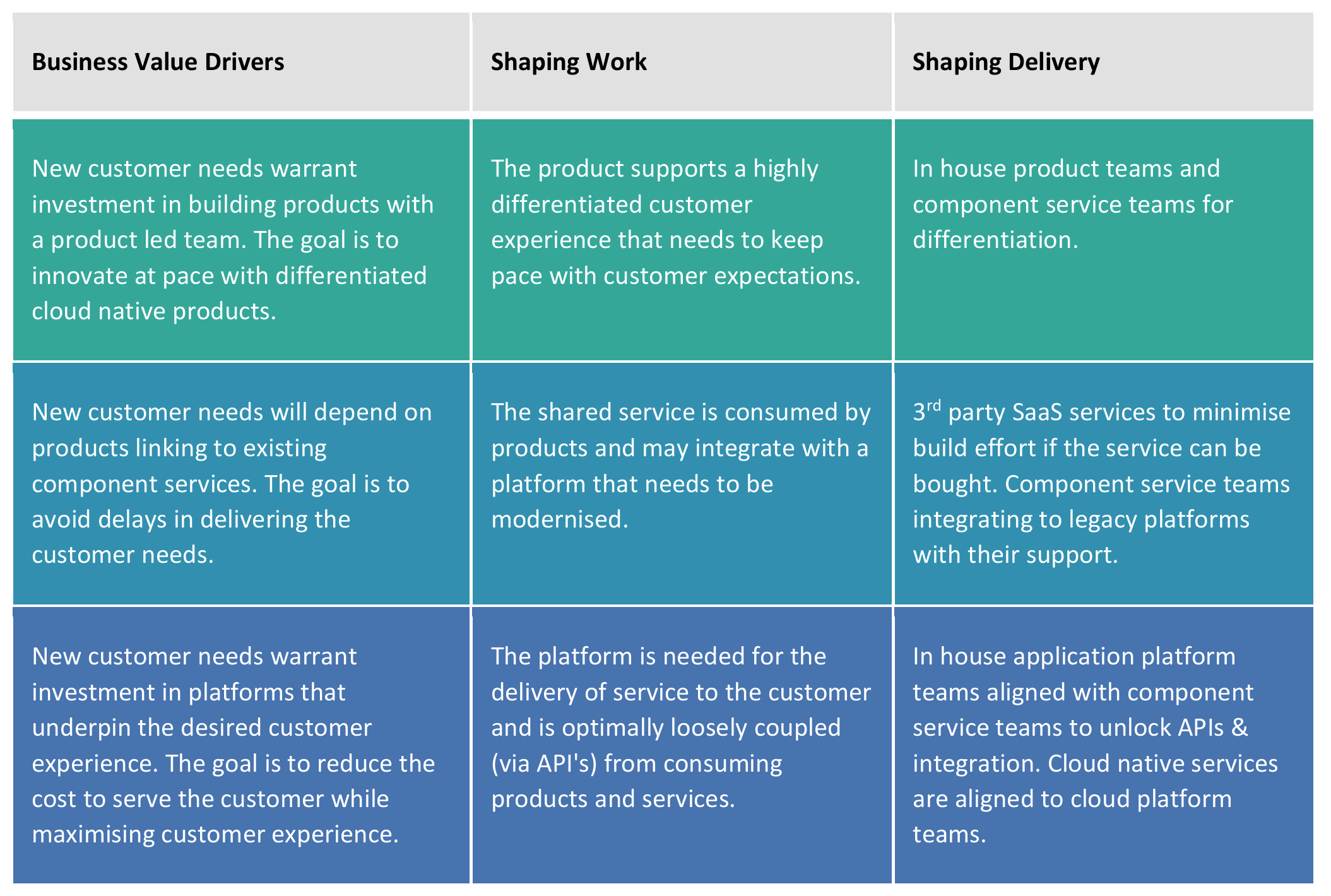
The following table shows how you might align business value drivers with the best approach to shaping work and the delivery of that work:
[2] Cloud To Modernise Your Portfolio
Modernising and migrating existing assets to the cloud typically starts with discovery and assessment and aligns the best fit based on several common transformation treatments. What this approach often lacks is ownership alignment with the teams that should receive the assets and sustain them in the cloud. By aligning ownership and value to your assets you will make better decisions and avoid stalling where attempting to transform with only a technology remit.

[3] Cloud To Accelerate Digital Excellence
For cloud to meet its true potential it must drive improvement where it will have the greatest impact across the 7 themes of digital excellence.

By focusing on your operating model, you can identify at depth the cloud benefits and measure the impact they have on your digital excellence and broader adaptability as you take on more opportunities and mature your cloud investment. Here is an indicative alignment of cloud enablement to digital excellence:

Related Insights


Contact Us
Get in touch with our team to learn more about our services, explore partnership opportunities or discuss how we can help with your challenges.