

Summary
The legal sector is facing a critical need to adapt their entire business model due to the transformative impact of generative AI (GenAI) and innovative start-ups.
Despite significant advancements in GenAI tools, many legal firms struggle to grasp the full scope of the opportunities and threats these technologies present.
Traditional billing models, inconsistent processes, and administrative-heavy operations are often barriers to innovation.
Failure to adapt will leave some firms behind, but those that do will achieve substantial gains in efficiency, market share, and profitability.
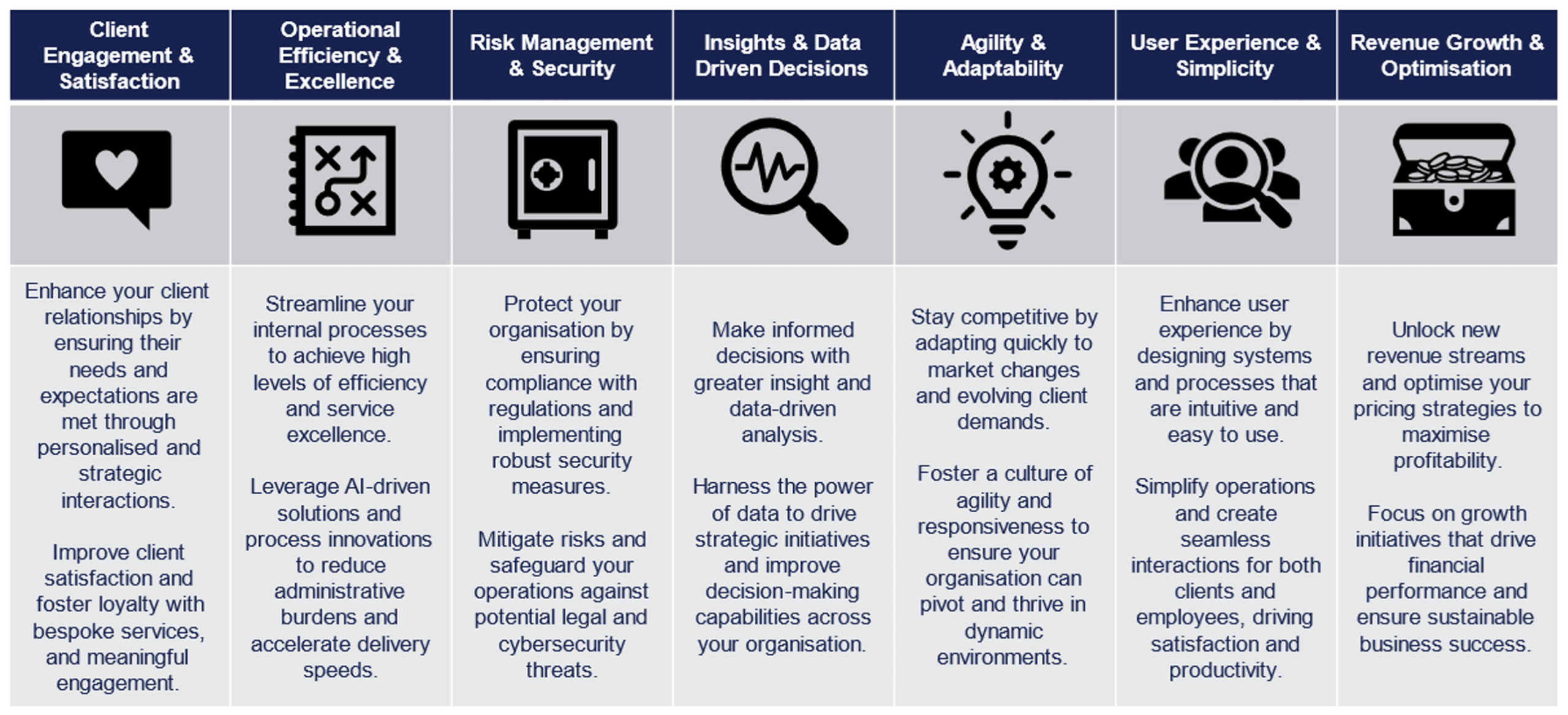
Mozaic’s proven 7 Dimensions of Strategic Advantage framework, provides a comprehensive method to navigate these changes, enabling prioritisation of each area of opportunity.
7 Dimensions of Strategic Advantage
The Legal Sector at a Crossroads
The legal sector is undergoing a seismic shift with the advent of generative AI (GenAI) and the rise of legal tech start-ups that make significant use of these capabilities. Challenging and redefining traditional practices and business models provides significant benefits for those firms willing to embrace change. Despite these opportunities, the sector’s adoption rates of AI and advanced Legal Tech offerings remain relatively low (20% have effectively integrated solutions according to a recent survey), reflecting varied levels of understanding and readiness to embrace change.
While most firms are running trials of solutions, few are actively building for use across their enterprises, or changing historic business models in-line with the changes that these tools can enable. Those that do try mass rollouts often note self-imposed limitations which hinder full capability and benefit realisation – security posture, legislative concerns, and client perception are all noted as contributing to these limitations.
Embracing AI & Innovation: Key Challenges to Overcome
Legal firms that fail to adapt to new technologies risk falling behind as client expectations of AI use will change rapidly as a few early adopters start to use the technologies more extensively.
There are however significant considerations to factor in to any successful implementation:
- High Cost: The initial investment in AI technologies can be substantial, but the long- term savings and efficiency gains often justify the expense. For example, adopting fixed fee structures and completing work faster can be a winning combination compared to traditional hourly rates, offering better cost efficiency and competitive pricing.
- Trust Issues: Building trust in AI solutions is crucial. Firms need to ensure that AI tools are reliable and transparent to gain user acceptance – hallucinations would introduce significant risk to matters. Understanding data classification, identifying information asset owners, and knowing the constraints around data usage are critical. Proper data management practices can help mitigate trust issues and ensure reliable AI implementations.
- User Interfaces: User-friendly interfaces are essential to ensure that new technologies are easily adopted by legal professionals. Simplified and intuitive interfaces can significantly reduce the learning curve and increase the acceptance of AI tools within legal practices. Ensuring that these interfaces align with the workflows of legal professionals will further enhance usability and productivity, as will internal communications surrounding their benefits and rollout.
- Training & Progression: As AI takes over more routine tasks, firms must rethink how they train, retain, and progress junior staff – e.g. Prompt Engineers have begun appearing in sectors more advanced in GenAI tool adoption. AI tools handling substantial amounts of junior-level work could lead to fewer learning opportunities for new lawyers. Developing new training programs and mentorship opportunities will be essential to ensure the continued professional development of junior staff.
- Changing Role of Existing Law Firms: With AI tools being increasingly used by in- house legal teams, the role of external law firms is changing. Firms must adapt by offering more specialised services and leveraging technology to provide added value that in-house teams cannot easily replicate. This shift requires firms to stay ahead of technological trends and continuously innovate their service offerings.
These implementation challenges are in addition to longer standing innovation blockers:
- Siloed Decision-Making: The traditional partner model in legal firms often results in fragmented innovation efforts and isolated decision-making processes.
- Regulatory Complexities: Multinational firms face a complex web of jurisdictional regulations and compliance issues that can hinder the adoption of new technologies.
- Resource Constraints: Many legal firms operate under limited budgets and resources, which makes it challenging to invest in new technologies and innovation initiatives.
- Cultural Resistance: Resistance to change is a significant barrier within many legal firms. Concerns about job displacement, disruption of established workflows, and the impact on traditional ways of working (and billing) contribute to a culture of inertia.
Embracing AI & Innovation: Benefits
Firms that can successfully navigate these challenges stand to gain significantly:
- Operational efficiency: AI can streamline processes, reduce manual workloads, and enhance productivity.
For instance, one firm reduced contract review times by 30% using an AI-powered document analysis tool, leading to a significant increase in operational efficiency and freeing up lawyers for more complex tasks.
- New service offerings: Leveraging technology can enable firms to offer innovative services, meet client demands more effectively, and open new revenue streams.
High-volume transaction services, such as patent applications, can be processed more efficiently, increasing profitability or market share through price reductions. - Enhanced client engagement: AI-driven tools can provide faster, more accurate responses to client inquiries, improving overall client satisfaction.
For example, firms using AI for client management have reported a 25% increase in client retention rates due to more personalised and responsive services. - Proactive risk management: AI can predict potential compliance issues, allowing firms to address risks before they become problematic.
One global firm, for example, used AI to monitor regulatory changes, reducing compliance breaches by 40% and avoiding costly penalties. - Agility and adaptability: Implementing AI allows firms to adapt more quickly to regulatory changes or shifts in client needs.
One firm reported a 35% reduction in the time required to implement new legal strategies, thanks to AI tools that streamlined the process. - Improved user experience: AI tools with user-friendly interfaces have been shown to reduce the learning curve for legal professionals.
A firm that implemented a new AI-powered legal research tool reported a 50% reduction in the time required for training, leading to faster adoption and increased productivity. - Revenue growth and optimisation: AI can uncover new revenue opportunities by identifying trends and client needs.
Firms that utilised AI for market analysis saw a 15% increase in revenue by introducing new, data-driven services and pricing models.
Building the portfolio
Navigating these complexities is difficult, and successful implementation requires more than isolated efforts; it demands cross-firm buy-in and transformation.
This is where clear assessment and articulation of the necessary changes, effort, and value is vital to ensuring that technology adoption is seamless and beneficial across all levels of the firm.
Mozaic’s 7 Dimensions of Strategic Advantage framework offers a proven approach to providing necessary structure, offering a holistic way to assess impacts, identify opportunities, and drive innovation through a quantified and prioritised portfolio of strategic and tactical activities.
7 Dimensions of Strategic Advantage: Framework Application
In the rapidly evolving legal landscape, firms require a structured approach to navigate the complexities of adopting new technologies. Our 7 Dimensions of Strategic Advantage framework provides this structure, ensuring that changes are comprehensive and aligned with the firm’s strategic goals.
By assessing and prioritising critical areas such as client engagement, operational efficiency, and risk management, this framework helps legal firms implement comprehensive changes that go beyond isolated initiatives. Leveraging this framework ensures cross-firm buy-in and transforms how services are delivered, ultimately enhancing competitiveness and growth.
This framework is tailored to each firm’s unique context, ensuring that the identified opportunities and challenges are addressed in a way that drives meaningful change.
Tailoring and applying the framework
Our approach is customised for the legal sector, focusing on the unique challenges and opportunities it presents. Key activities and milestones in our engagements include:
Initial assessment
Assess (define) organisational objectives and strategy:
- Evaluate whether clear and measurable goals are established and understood across the organisation in relation to Innovation.
- If such goals do not exist, collaborate with key leaders to develop a vision supported by a strategy and objectives aligned around the 7 Dimensions of Strategic Advantage.
- This step ensures that all subsequent actions and initiatives are aligned with the overarching strategic vision, providing a clear roadmap for innovation.
Framework application
Impact assessment:
- Apply the framework to assess the potential impacts (both positive and negative) of AI and similar innovations across various service lines.
- Impact Definition: Define how AI and similar EmTech advancements might affect the organisation. A negative impact is seen as a threat, while a positive impact is viewed as an opportunity.
- Focus on each of the dimensions across Client Engagement, Operational Efficiency, Risk Management, Data-driven Decisions, Agility, User Experience, and Revenue Growth.
- A mix of workshops and stakeholder interviews are used to identify specific impacts and associated operating model / strategic challenges.
- For example, a firm might identify that AI could streamline contract review processes, reducing time by 30% but requiring a significant change in how legal teams are structured, necessitating parallel change activities.
Idea generation:
- After understanding the impacts, generate ideas and proposals that align with these impacts to mitigate threats and capitalise on opportunities.
- Shift the approach towards creation of a high quantity of ideas, ensuring broad coverage of potential solutions at this stage.
- To ensure alignment of the goals to the organisation’s strategic objectives, spend time analysing the insights from the impacts, ensuring the opportunity statements created to ideate around are aligned to the impacts identified and the organisational objectives.
- For example, an imapct of falling revenue and an organisational goal of growing revenue by X% will ensure the opportunity statement is aligned to ideas to increase revenue.
- This step also involves filtering and categorising ideas to ensure they are relevant and actionable, helping the firm to focus on high-impact initiatives.
Engagement method
Inclusive collaboration:
- Engage staff and colleagues across all levels of the organisation through workshops and interviews to ensure cross-spectrum involvement and facilitation of the broadest set of inputs.
- Foster a culture of innovation by encouraging active participation and collaboration, ensuring that the insights gathered are comprehensive and reflective of the entire organisation.
- Workshops should be approached with a mixture of ‘silent and solo’ work coupled with group discussion to ensure a broad range of voices and working styles can be accommodated.
- This mixed approach allows for both individual creativity and collective brainstorming, ensuring that no valuable insights are overlooked.
Building the portfolio & innovation pipeline
Prioritisation of initiatives:
- Develop an innovation pipeline to manage and track the progress of new ideas and technologies.
- Prioritise potential solutions based on their impact and the effort required to implement them. Note, at this stage the initiatives are likely not refined.
- To prioritise the high quantity of proposals generated from the earlier process steps, a cross functional team will be engaged to both refine and weight / score each item.
- A variety of frameworks can be used in support of this from simple “impact vs effort” matrices to more detailed approaches like “RICE” (Reach, Impact, Confidence, Effort) or “WSJF” (Weighted Shortest Job First) by means of creating a visual representation of where initiatives stand.
- Specific frameworks and the application of one of Mozaic’s proprietary weighting mechanisms are determined case-by-case in collaboration with the organisation, ensuring appropriate robustness.
- Historic data can also be used to support this process such as looking at similar initiatives done previously. This can help, for example, when looking at ‘Confidence’ within RICE or ‘Development Size’ in WSJF.
- It is expected that out of this process the high quantity of initiatives – tactical and strategic – originally generated will be whittled down into a selection the team believes (at this stage) will deliver highest value to the organisation.
Impact and effort definition:
- Impact: Consider how closely an initiative aligns with the organisation’s strategic objectives (e.g. OKRs) and its potential to achieve those goals.
- For instance, aligning an idea with strategic objectives might involve scaling an in- house developed tool to offer a SaaS solution to clients, offering a new revenue stream which could support broader firm goals while also being practical in terms of resource allocation.
- Effort: Evaluate the resources, time, cost, and complexity required to implement the initiative.
- Effort measurements will be tailored appropriately to align with internal metrics and tooling (e.g. smallest time recording units). This could include leveraging historical project data to better estimate resource allocation and potential bottlenecks, ensuring a realistic and actionable plan.
Strategic initiatives
Refining the portfolio:
- Refine the highest-value work generated during the ideation phase to ensure they are feasible, desirable, and viable. Generate associated business justifications / cases to underpin investment decisions.
- This will allow a more comprehensive iteration of the portfolio to be created and fuller understanding of dependencies and constraints to be articulated.
Implementation and continuous delivery:
- A product-centric approach is highly recommended to focus on delivering value continuously through iterative development, ensuring that work types / services are continually refined based on client feedback and market changes. Where organisational or operating model maturity is required to enable this, it should have been built in to the holistic change portfolio through the refinement process.
- An example of the above, could be the introduction of a whole new revenue-generating service and the recruitment, training, technology, marketing etc that would be needed in order to deliver this to market.
- By implementing a continuous cycle of building, testing, and iterating on the design and solution, a focus can be maintained on early and continuous delivery of valuable outcomes.
- Provide ongoing guidance, support, training, and resources to ensure successful integration of new tools and methodologies across the firm.
Conclusion
The 7 Dimensions of Strategic Advantage framework and our comprehensive engagement process help legal firms develop a manageable portfolio of initiatives, ensuring that innovation is continuous and sustainable.
This approach not only addresses current technological challenges like GenAI but also prepares firms for future EmTech advancements, embedding a culture of ongoing improvement and adaptation.
Case Study: Supporting a Multinational Law Firm to Harness AI & Innovation
Background
A multinational law firm engaged Mozaic to assess the impacts and opportunities presented by GenAI and other EmTech. The objective was to enhance their innovation portfolio and ensure the firm remained ‘Future Facing’ in its solution adoption and planning across various Practice Groups.
The Challenge
The firm faced challenges in engaging their Practice Groups, developing a detailed analysis, overcoming embedded traditional models, prioritising fee-earners’ time, and addressing fears & anxieties surrounding technological advancements. Despite having a mature Innovation Function, their initiative pipeline needed strengthening. They required a comprehensive framework to identify opportunities, assess impacts, and prioritise initiatives across the firm, appreciating these would extend beyond technical solutions to challenge core business models and strategies.
The Approach
Initial assessment:
- Conducted a series of workshops involving attendees from a full range of fee-earning and non-fee-earning roles, including partners, associates, and paralegals.
- Gathered insights on current processes, pain points, and strategic goals to ensure alignment with the firm’s overarching objectives.
Framework application:
- Applied the 7 Dimensions Of Strategic Advantage framework to categorise hundreds of impacts and ideas generated during the workshops.
- Focused on impacts and opportunities related to Client Engagement, Operational Efficiency, Risk Management, Data-driven Decisions, Agility, User Experience, and Revenue Growth.
- Example impacts identified included softer, people implications relating to future lawyer skills and capabilities working alongside AI, and how through various initiatives, partner time could be freed up to increase client-facing interactions and business development activities.
Inclusive collaboration:
-
Facilitated sessions to encourage collaboration and foster a culture of innovation within the firm, ensuring buy-in from all parts of the business.
-
Enabled cross-functional teams to develop a comprehensive picture of the opportunities and impacts of GenAI.
-
To ensure all workshop participants were listened to and had their inputs captured, a mixture of individual and group activities were utilised.
- Impacts were captured individually, before being clustered via an ‘Affinity Mapping’ technique by all attendees leading to a shared understanding.
- For ideation, a ‘6-3-5 Brainwriting’ activity was utilised, allowing attendees to work in silence, before building on other participants’ ideas, followed by group discussion and voting.
Developing the innovation pipeline:
-
Prioritised ideas based on feasibility and potential impact, using Mozaic’s proprietary weighting mechanisms.
-
Created an innovation pipeline to manage the development and implementation of these ideas, ensuring continuous review and adaptation.
-
Engaged a cross functional team to prioritise initiatives by further estimating impacts and efforts of each, and then applying scoring, weighing, ultimately plotting on a matrix and offering a robust audit trail.
- Impact was quantified through scoring as how much of a difference would be made to the organisation, with key weightings around urgency, volume of practice groups impacted, and alignment to strategic goals (e.g. growing revenue, gaining market share or internal time savings).
Key insights and outcomes
-
Holistic business changes: The facilitated sessions produced a significant list of ideas addressing business changes across all 7 dimensions of the framework.
-
Enhanced ownership and engagement: The engagement increased thinking about and ownership of innovation agendas within each Practice Group, with teams becoming more proactive in identifying and driving relevant changes.
-
Detailed understanding: The organisation developed a detailed micro picture of how GenAI would impact various work types, enabling more informed decision-making and prioritisation of initiatives.
- The organisation knew more about which worktypes were threatened by AI, whether via anticipated (new) competitors entering the market, competitors deploying solutions to reduce costs and/or solutions becoming readily available that enables clients to take matters in-house. Higher prioritisation filters were applied based on proximity of these threats and ease by which they could be mitigated.
Next steps
-
Implementation of initiatives: Taking forward the prioritised initiatives with a clearer understanding of the holistic changes required to enable and enact them.
-
Sustained engagement: Ensuring continuous engagement and ownership within Practice Groups to drive ongoing innovation.
-
Integration with delivery pipeline: Aligning initiatives with the firm’s product- orientation, ensuring that changes are driven by those involved in day-to-day work for better success and adoption.
Conclusion
By applying the 7 Dimensions Of Strategic Advantage framework, the organisation was able to identify and prioritise a comprehensive portfolio of opportunities for AI adoption, across enhancing operational efficiency and implementation of innovative new service offerings.
This case study exemplifies how a structured approach to transformation can help legal firms embrace innovation such as GenAI tools and be Future Ready in a rapidly evolving market.
Conclusion and Recommendations
The legal sector is undergoing a transformative period driven by the advent of generative AI (GenAI) and the emergence of innovative start-ups. Despite the potential benefits, many legal firms struggle to fully understand and leverage these new technologies. Key challenges include siloed decision-making, regulatory complexities, resource constraints, and cultural resistance to change.
Our 7 Dimensions Of Strategic Advantage framework offers a structured approach to help legal firms navigate these challenges. By focusing on client engagement, operational efficiency, risk management, data-driven decisions, agility, user experience, and revenue growth, this framework enables firms to develop innovation pipelines, engage their teams in identifying solutions, and lay the groundwork for transforming their service delivery and pricing models.
Recommendations
To successfully implement the 7 Dimensions Of Strategic Advantage framework and achieve the desired outcomes, legal firms should consider the following recommendations:
Holistic integration:
Ensure that technology adoption is not a siloed activity but integrated across the firm with buy-in from all levels.
Client-centric approach:
Engage with clients to understand their needs and pain points, using technology to improve interactions and satisfaction.
Operational efficiency:
Conduct a thorough assessment of current processes to identify areas for improvement and implement AI and automation tools to streamline operations.
Agility and flexibility:
Create a flexible organisational structure that can quickly adapt to changes in the market and implement agile methodologies to drive innovation.
Comprehensive training programs:
Develop and implement training programs that are relevant and beneficial to staff at all levels, ensuring they are well-prepared to adopt and leverage new technologies.
Data-driven decisions:
Leverage data analytics to inform decision-making and identify new revenue opportunities, implementing value-based pricing models that reflect the benefits provided by new technologies.
Enhanced security and compliance:
Use advanced security and data access measures, ensuring that data is only accessed when there is a business need, with proper visibility of the Information Asset Owner(s).
Call to action for legal firms
Legal firms must act now to navigate the complexities of innovation and ensure they remain competitive.
By leveraging Mozaic’s experience and our 7 Dimensions Of Strategic Advantage framework, firms can harness the benefits of new technologies, drive strategic advantage, and position themselves as leaders in the industry.
We invite you to partner with us on this journey of transformation.
Our tailored approach, deep industry expertise, and commitment to delivering measurable results make us the ideal partner to help you navigate the challenges and opportunities of the digital age.
Together, we can ensure you are Future Ready.
Related Insights


Contact Us
Get in touch with our team to learn more about our services, explore partnership opportunities or discuss how we can help with your challenges.