

Many businesses already possess powerful IT tools, yet they often fail to realise the full extent of their potential. Service management platforms, initially adopted for IT service management, can be extended to enhance workflows across various corporate and back office functions, unlocking significant benefits that stretch far beyond their original scope. By integrating these tools across the organisation, companies can cut costs, increase efficiency and improve user experiences, all while maximising their existing investments. Exploring this potential allows organisations to reap broader, often unexpected rewards without the need for additional spending or complex implementations.
Many organisations are unaware of the untapped value in their existing IT tools and platforms, typically owned by their CIO. Although service management transformation is primarily thought of as an IT-driven initiative, more organisations are realising that extending service management beyond IT can unlock tremendous value for the broader business. According to a recent ITSM.TOOLS survey, 50% of organisations are already planning or actively extending service management beyond IT. However, this can contribute to high rates of tool churn, with 33% of organisations changing or planning to change their service management tools in the near future.
This tool churn often stems from underutilisation or misalignment of current usage and capability. Companies might not fully capitalise on the tools already available, leading to missed opportunities. The fundamental objectives of Enterprise Service Management (ESM) are to improve efficiency, reduce costs, and enhance service quality across all business functions. Yet many organisations overlook the potential of their current service management tools, which can deliver up to a 20% reduction in combined capital and operating costs and can be leveraged across various business functions such as Facilities, HR, Legal and Procurement.
The key however to successfully extending service management tools across the enterprise is adopting platforms that offer flexible, predictable pricing models.
By adopting platforms that offer flat pricing models, organisations can streamline service management processes without the risk of escalating licence costs. Additionally, many of these newer platforms are highly configurable, offering low-code or no-code solutions that reduce the complexity of deployment and the need for specialised skills. The flexibility to create workflows and automate processes across departments such as HR, IT, and procurement can enhance user experiences and drive productivity without significant investment in new technology.
Platforms with these capabilities can also deliver additional benefits such as a 20% increase in productivity, a 40% reduction in forms, and a 75% decrease in compliance-related workloads. By leveraging existing tools with the right pricing models and configurations, organisations can unlock hidden value without incurring excessive costs or delays.
The schematic diagram below represents the value/cost curves based on the different pricing models to show how beneficial flat licensing costs can be in creating momentum and demonstrable value with incremental investment in ESM transformation.
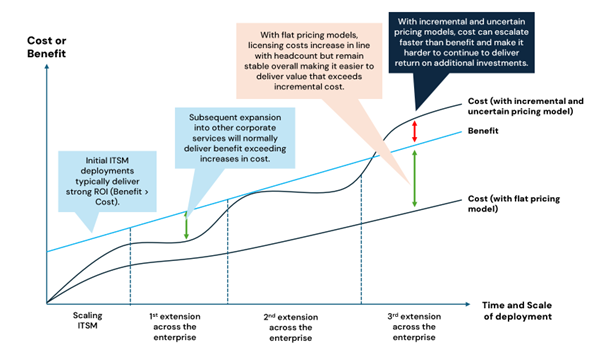
There is a conventional wisdom that organisations will typically implement IT Service Management workflows first (which is common) and then extend across the enterprise. However, as explored in the diagram above, many organisations fail to progress beyond IT as the costs from additional licences and licence types as well as the required expertise to configure new modules can present a barrier to justifying ongoing transformation of additional functions and services. As explained above, it need not be the case.