

The Importance Of Cultural Change
When transitioning to an Enterprise Product operating model, enabling and maintaining an appropriate, effective culture is critical to success. In this paper, we discuss what it takes to realise such a culture and looks at some of the common pitfalls along the way. Importantly, we address the importance of coaching throughout any transformation journey.
Culture is often either misunderstood or ignored in favour of “Ways of Working”, both in transformation and in the general running of an organisation. The concept of Culture (alongside strategy) is often misquoted or misused; it is not a “better way”, and is not obtained by forcing change on people, but instead must evolve and grow over time to stabilise and take effect.
The reason for this is relatively simple: culture is how we consciously and unconsciously behave and is often the “Why” – and in some ways, the who – behind the what, how, and when.
Good Culture?
What represents good culture is difficult to define, as it’s extremely contextual. For example, even though it may sound very undesirable, in a total crisis (true chaos), a draconian dictatorship may be appropriate to manage the situation, and the culture at the time needs to support it. The good news is this is seldom required.
An operating model centred around product supports the organisation’s strategic goals by encouraging individual human strengths and interactions, creating fast feedback loops with candour and constructive data, and improving transparency so that everyone can see how they connect to customer value.
In this context, the characteristics of a positive environment and culture include:
- Empowerment AND accountability
- Bringing work to the people
- The team is responsible for the total work
- Processes should support inspect and adapt
- A focus on customer needs and wants
- There should be a clear sense of belonging and purpose
- Visibility and transparency
Positive Characteristics Of A Team
The positive characteristics of a product team are:
Empowerment AND accountability: Teams are accountable for what they deliver, enabled by the decision-making authority and agency they need to be successful.
Bring work to the people: Teams are built with cross-functional capabilities and pull work, rather than temporarily being aligned around specific work. This allows persistence and helps flow work effectively through the system.
Total Work: Teams align around discrete pieces of work, with full authority required to pull, run, maintain, and improve, not just build the “shiny new”. Work should be defined by the capacity of the team, and capacity should balance against utilisation.
Inspect and Adapt: Teams work in a safe environment where they can experiment, with rapid feedback to allow action and iteration.
Focus on customer needs and wants: teams enable products to evolve throughout their lifetime, ensuring they continue to meet changing customer needs and expectations.
Clear sense of belonging and purpose: Individuals have a sense of belonging to their team, and the team is accountable for success, not the people. Teams have clear identity and purpose.
Visibility and Transparency: Leadership honestly articulates the Why to teams and supports their needs. Teams are proud of what they deliver and find every opportunity to communicate what is being done and the progress that they have made.
Affecting Cultural Change
Your culture results from the interactions between people and teams, and this, therefore, is the crux of any transformation – not systems, policies, governance, or management direction. Whether these things are effective or not will be dependent upon the culture and the interactions of your people.
As your organisation changes, your culture needs to align with the change – your people will need to adapt and will therefore invariably require support through the journey. Change is often uncomfortable for those affected, at every level in the organisation. Coaching is, therefore, a critical enabler – it is a method of facilitative leadership for complex, uncertain spaces, designed to be the “grease in the wheels” at multiple levels.
Coaching is designed to help individuals and teams become better at what they already do, broaden their horizons to incorporate new thoughts and understanding, and potentially find better ways to do things. It is the most effective approach to facilitating complex transformations, and the interactions and behaviours within complex human systems.
It is important to realise that coaches do not deliver things per se, and are not limited to one framework or method, but rather facilitate improvements in others with the most appropriate approach. Coaches are there not to direct, fix, or improve, or to provide a solution, but to:
- Map the contexts
- Help understand and change the language
- Nudge changes in actions to prevent a continuation of what is currently ineffective Surface where issues and constraints lie
- Help find paths to unblock or repair, and, with co-creation, help the organisation and teams do this for themselves on a sustainable basis
- Help the people feel safer, more engaged, and to learn how to effectively find their own solutions
- Explore and surface hidden issues
- Help create enabling systems – linkages and enablers at a systemic and persistent level
Therefore, coaching is most effective in complex, uncertain, uncomfortable human systems to challenge default patterns of behaviour and encourage the evolution of better-fit behaviours.
Coaching is well-positioned metaphorically as a “tri-ski” approach:
- Ski in front to “show how” and guide
- Ski beside to advise, nudge, and improve
- Ski behind to shadow, monitor, and encourage
…and then simply slow down and let them “carry on skiing” independently.
Approach
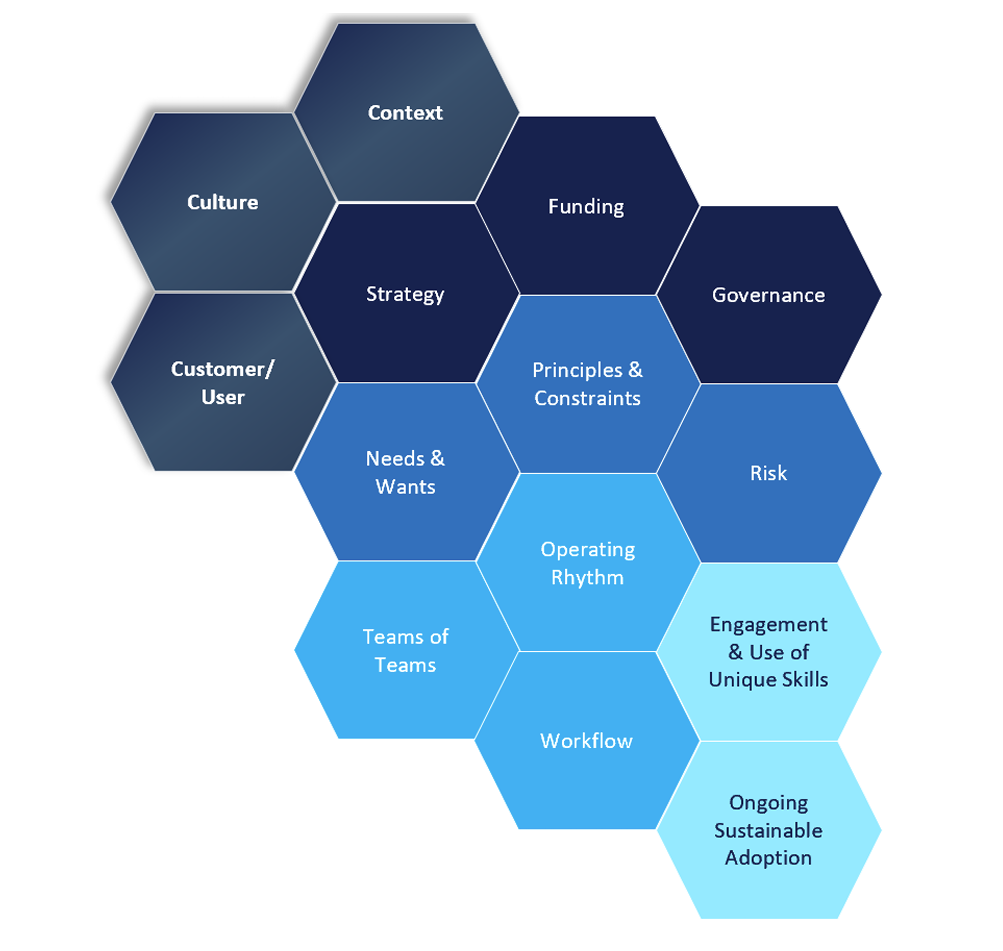
There are 3 key pieces to any model of operation sustainably succeeding:
- Understanding the context we are really within
- Having the right culture to support our journey
- Understanding the wants and needs of our users or customers
Everything else depends upon these, and Coaching fits all the way through the model.
Coaching Enablers
Experience across industry has proven that supporting a coaching capability (for example, a true “Centre of Enablement” or “Hub”) enables teams to empower themselves, find the methodology appropriate to their specific workflow and archetype, create a better culture, deliver optimally, and be more engaged and innovative in their approach.
Having coaching exist in its own practice area on a pull basis for teams which are either:
- Operating effectively and wish to improve and find new, better ways and more optimal paths or to explore new paradigms
- Experiencing genuine pain points and have deeper level problems they need to resolve
…allows the uniquely diverse functions, archetypes, and goals to be supported and evolved without out-of-context and unsustainable “cookie-cutter” solutions being imposed on teams according to a predefined framework or playbook.
Language and Culture
Underpinning cultural change, language is a fundamental foundation.
Language drives the understanding and equity of voice required to explore the best-fit culture and behaviours. Most transformations exist above the line, and coaching addresses what lies beneath: the fundamental aspects of success.
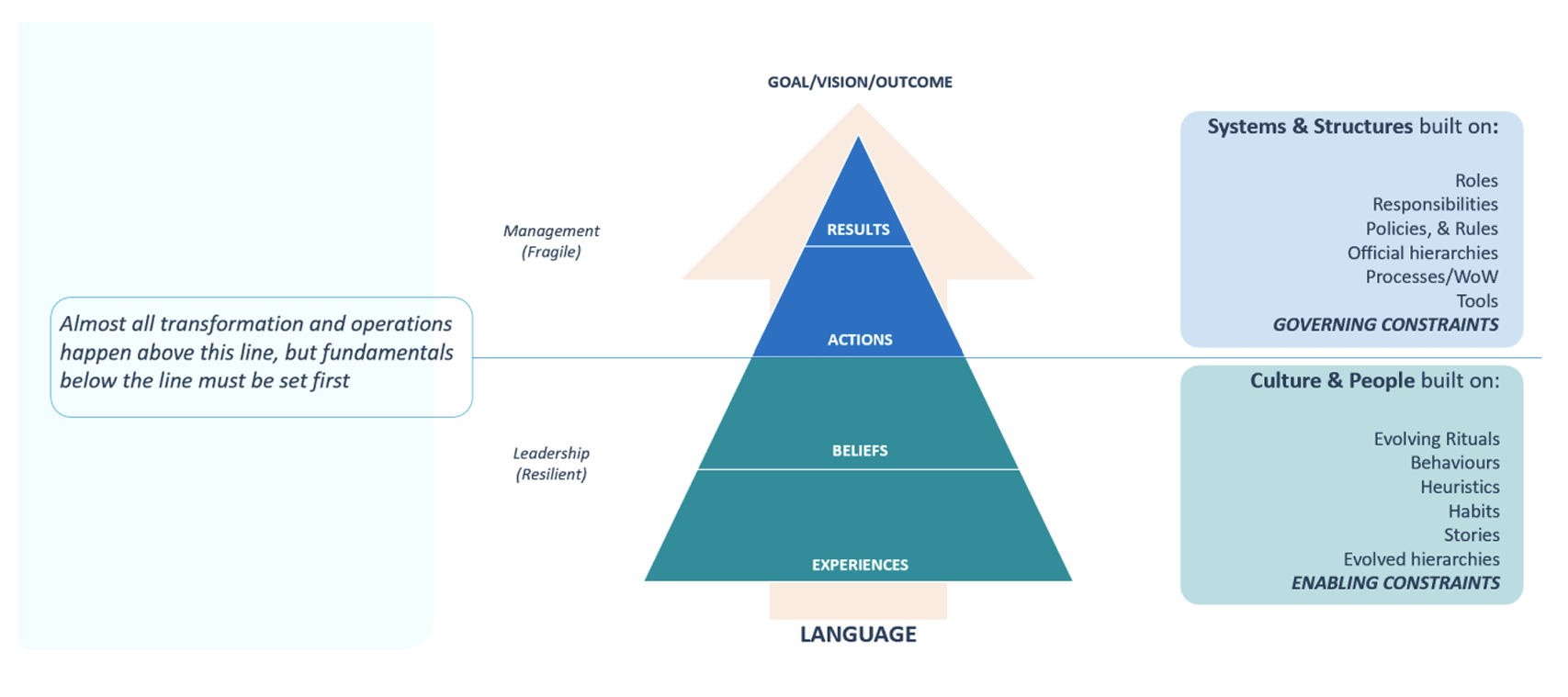
Language is the single most critical element to set at the outset and may be uncomfortable to change, requiring radical adoption. Without intentional action regarding language, prejudices will be allowed to fester, and confusion will likely reign. Words may have different meanings to different people, without a reset, this will continue.
As seen in the Results Pyramid, the language which sets correct behaviours, the narratives which an organisation runs on, and the sustainable actions to achieve outcomes all lie in the realm of culture and leadership. The correct language is required to demonstrate intent, help create psychological safety, and engender transparency in communication. This becomes the foundation for cultural change.
Cultural Failure
If culture isn’t addressed when change is required, little will fundamentally change – poor behaviours will continue, and ultimately the organisation will decline. At best, old behaviours and practices will creep back in.
Symptoms of a failing culture include poor or suboptimal delivery, toxicity and micromanagement, a lack of acknowledging the humans in the system, loss of innovation, high attrition, loss of traction in the market, gaming organisational metrics to hide performance (often up to board level), and an increasing focus on the short term with results reflected by these metrics.
Internally, this is often accompanied by management out of control trying to prove, triage, and firefight; alongside the hubris of “hero leaders”, who become increasingly detached from reality due to poor data and a desire to only hear positives – all of which accelerates the decline of an organisation, increases the likelihood that weak signals and critical inflection points for change will be missed, and promotes final-days empire-building internally in an attempt to maintain personal benefits through structure. None of this is good for the organisation, obviously.
Patience is a Virtue
If you want a transformation to succeed, you must give it time, focus on changing the environment and supporting the people, the right measurements, and trusting the people who, ultimately, will be transforming the company through an evolutionary process over time.
Interactions are dictated by the experiences people undergo, which define beliefs, which define actions they take long-term; you can force faster changes through bureaucratic structure, but it will not sustain or embed, and ultimately, without these fundamental aspects addressed and allowed to evolve themselves before anything else, whatever other changes occur will fail past the immediate short-term. Discovering and addressing culture must always come first, or everything else we do will not matter.
Change is Good
Importantly, the characteristics of a positive culture for product-orientation represent a culture that most of us would prefer to work in. Who doesn’t want to be empowered, have the space to learn and adapt, own the whole problem and be able to focus on their customers’ wants and needs?
These represent the environments in which people thrive in and wish to work in.
Of course, change cannot happen overnight, and culture cannot be imposed top-down – leaders must lead and not manage. Similarly, leadership cannot be bestowed upon individuals, Leaders will naturally lead, regardless of who they are and their allocated role in the organisation.
Finally, patience is a virtue. Change is difficult but perseverance, getting it right is the difference between organisational success or failure.
If you’d like to know more about the approach to cultural change or are embarking on your journey and would like to benefit from deep experience, please contact info@mozaic.net, or contact either of the authors – contact details on the following page.
Related Insights


Contact Us
Get in touch with our team to learn more about our services, explore partnership opportunities or discuss how we can help with your challenges.