

Executive Summary
Artificial Intelligence has moved beyond experimentation. For modern enterprises, AI is now a board-level imperative, reshaping competitive dynamics, operational decision-making, service delivery, risk management, and organisational design.
The message is clear: Maturity and productivity of AI implemented solutions in an organisation cannot outpace the AI governance that surrounds them
This paper, a part of The Organisation of the Future series, outlines Mozaic’s recommended Future State AI Governance Model; a cohesive, enterprise-wide framework that enables organisations to safely scale AI, unlock economic value, and maintain trust with customers, regulators, and society. We recommend a practical approach to building governance, with structures and approaches that enable you to start to operationalise the future ways of working.
The Mozaic AI governance model combines:
- Enterprise oversight and decision rights.
- Ethical and regulatory compliance.
- Data governance, security, and model assurance.
- Human-in-the-loop principles.
- Continuous monitoring and lifecycle control.
- Organisational structures enabling sustainable adoption.
This is not a “compliance add-on”; it is an operating model revolution that paves the way for the AI-enabled Organisation of the Future.
Governance must evolve to avoid significant risk
AI is accelerating across the enterprise, but organisations lag behind in governance capability:
- 95% claim to have an AI strategy, but only 13% are ready to scale it sustainably.
- 67% of data leaders do not monitor model drift or bias.
- Over 50% of organisations lack AI risk frameworks aligned to emerging regulations.
- 80% of companies have experienced unintended AI actions by generative agents.
AI introduces risks beyond traditional IT governance including explainability, fairness, automation bias, autonomous action, emergent behaviour, data leakage, and legal accountability.
The lack of a clear governance framework results in:
- Disconnected AI pilots.
- Undefined ownership.
- Weak assurance pathways.
- Exposure to legal and ethical failure.
- Erosion of public trust.
- Lost productivity and unrealise
AI will determine future competitiveness, but only if organisations govern it deliberately, boldly, and coherently. We all inherently recognise the benefits that AI and other emerging technology bring, but failure can be extremely serious. Major, publicly visibility, failures resulting from poor governance surrounding technology implementations have been with us for years, resulting in anything from massive financial impacts, regulatory failure, reputational damage to court cases and public outrage.
But, organisations that create the right foundations will win. These can be summarised as having the following attributes:
Adaptive Governance
Fast, risk-based governance that balances innovation with protection.
Enterprise AI Literacy and Culture
A workforce that understands how to evaluate, challenge, and responsibly use AI outputs.
Federated Accountability
Local ownership embedded in business units, supported by central guardrails.
Outcome-Driven Operating Model
AI governance tightly coupled with value, not just risk mitigation.
Trust by Design
Embedding fairness, transparency, and human oversight into all systems.
The Future State AI Governance Model
Mozaic’s future-state design is built around seven foundational principles derived from our AI Governance Pillars, industry benchmarks, and regulatory direction.
- Enterprise Oversight & Accountability
AI must be guided by clear authority, transparent decision-rights, and a governance board responsible for outcomes
- Ethical, Lawful & Responsible Use
Governance ensures AI reinforces organisational values, mitigates discrimination, and aligns with legal frameworks.
- Transparency & Explainability
Users, stakeholders, and regulators must understand how AI influences decisions.
- Regulatory and Legal Assurance
AI must be compliant by design, with embedded checks for GDPR, Equality Act, and evolving UK/EU AI legislation.
- Data Governance & Security
AI is only as safe as the data behind it, requiring robust protection, lineage, and minimisation practices.
- Human Oversight & Decision Support
AI should augment, not replace, human accountability, with clear HITL thresholds.
- Continuous Improvement & Monitoring
AI governance must evolve continuously, reflecting rapid shifts in risk, technology, and regulation.
Taking these, we recommend building a three governance layers model, ensuring clarity in decision-making, assurance and delivery, and taking a risk-based approach to delivery.
Layer 1
Enterprise Leadership & Strategic Governance
Strategy Governance Board (AIGB)
A cross-functional, board-endorsed forum with responsibility for:
- Enterprise strategy (taking into account AI and other emerging technologies in every decision)
- Risk & compliance oversight
- Investment prioritisation
- Ethical review and societal impact
- Approval of enterprise AI standards
Membership: CIO, CDO, COO, CHRO, CRO, General Counsel, Chief Ethics Officer, plus rotating business-unit leaders.
Executive AI Sponsor
Champions the AI portfolio, ensures alignment to organisational goals, secures funding, and unblocks cross-functional issues.
AI Policy & Regulatory Oversight Function
Provides interpretation of regulations, ensures alignment to legal standards, and maintains a future-ready policy framework.
Layer 2
Operational Governance & Assurance
AI Centre of Excellence
- Sets enterprise-wide standards, policies, and guardrails.
- Defines Responsible AI principles and compliance frameworks.
- Establishes best practices for risk management, ethics, and assurance.
- Provides training, tooling, and advisory support across the organisation.
AI Product Councils
The organisational engine for safe adoption. Responsibilities include:
- Portfolio-level governance and prioritisation.
- Evaluates AI initiatives for business value vs. risk.
- Approves or rejects work based on ethical, regulatory, and strategic fit.
- Acts as a ‘bridge’ between CoE standards and operational execution.
- Providing enterprise enablement and training
- Coordinating the communities of practice
- Authoring AI lifecycle methods & toolkits
Model Operations Function
A dedicated assurance capability providing:
- Embedded governance in day-to-day AI model lifecycle.
- Deploys, monitors, and retrains models with governance checks (bias detection, explainability, audit trails).
- Ensures compliance is automated within pipelines.
- Provides feedback loops to AI Product Councils and the CoE when risks or anomalies are detected.
This function acts as the second line of defence, independent from model-building teams.
Data Governance Office
Ensures:
- High-quality, well-governed datasets
- Data lineage/provenance tracking
- Controls for minimisation, access, anonymisation
- Cybersecurity measures to prevent model attacks
Layer 3
Delivery, Adoption & Local Controls
AI Product Owners & Use-Case Squads
Drive accountable delivery of AI features within business domains based on risk profile.
Human Oversight Leads
Role embedded in business units, responsible for:
- Determining “override” scenarios
- Ensuring situational awareness
- Mitigating automation bias
- Checking appropriateness of AI recommendations
AI Community of Practice
A cross-enterprise capability fostering shared learning, standards adoption, and rapid innovation diffusion.
Through the Mozaic governance structures, the Future Ready model defines unambiguous ownership:
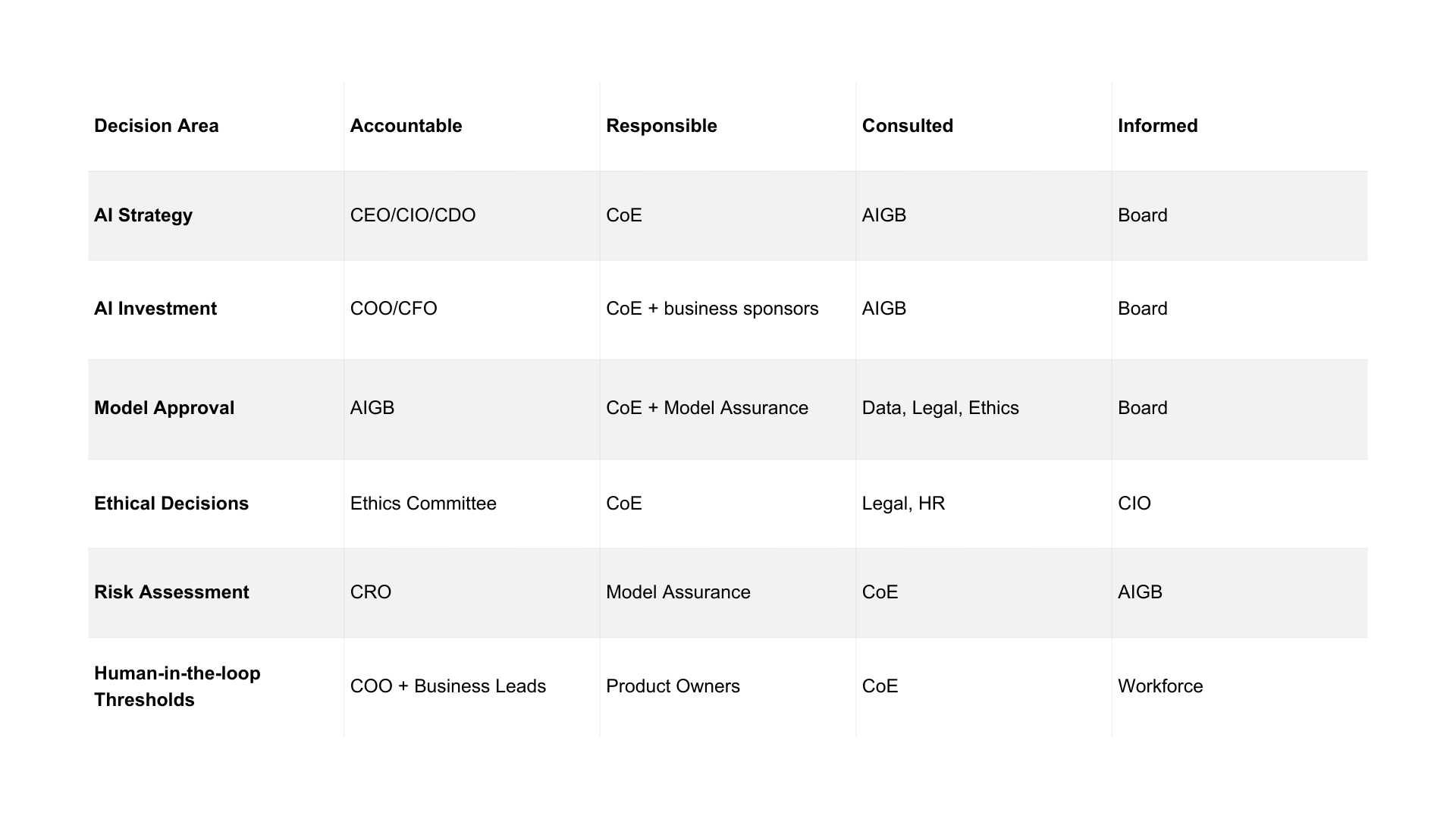
This clarifies who decides, who builds, who assures, and who owns outcomes.

For the Commodity and Utility services:
This robust governance model must span the end-to-end AI lifecycle as shown below, regardless of using market available capabilities, building your own solutions or sourcing delivery from suppliers and partners.
Strategy Definition
- AI ambition, principles, policies, and funding priorities
- Acceptable Use of AI Policy
- Risk appetite and guardrails
Design & Build Governance
- Establish governance layers
- Operationalise governance with appropriate technology support (e.g. automated bias detection, model lineage tracking etc.)
- Data quality checks
- Model documentation and explainability assets
- Bias and fairness audits
- Testing & validation pathways
- Third party AI risk management protocols
Training and Culture
- AI governance change programme
- Role based training
- Gamified learning modules
- Governance champions
Deployment Governance
- Go-live approval
- Controls for safety, resilience, and legal compliance
- Integration into operational support models
Monitor & Sustaining the models
- Drift detection
- Re-training triggers
- Audit logs and traceability
- Incident escalation and redress mechanisms
Improvement & Renewal
- Continual measurement (look out for the upcoming paper in this series on this topic)
- Observability-driven enhancement
- Periodic ethical reviews
- Framework updates aligned to regulatory change
Conclusion
AI will define the competitive horizon for the next decade; but only if organisations embed future-state governance models that are intentional, transparent and strategically aligned.
AI’s risks evolve rapidly and so must governance; it is core to any organisations ability to safely and responsibly adopt emerging technologies and realise the expected benefits.
The organisations that succeed will be those that treat AI not as a technology trend, but as a governed enterprise capability, underpinned by clear structures, accountable leadership, ethical discipline, and continuous assurance.
Mozaic’s Future Ready AI Governance Model provides the blueprint.
What Next?
Free Executive Alignment Briefing
Move from pilots to outcomes with a shared executive view.
To help leadership teams act with confidence, Mozaic is offering a free executive alignment session. This is a focused session for your board or ExCo to develop a common understanding of what AI adoption really means for your organisation: where value sits, the risks to manage, and the potential operating model changes required across functions, processes, governance, data, tooling, sourcing and people.
In this session we will…
- Clarify your strategic intent and risk appetite for AI
- Map key implications across Mozaic’s seven operating model dimensions
- Identify 3-5 priority focus areas and the preconditions for success.
You will receive…
- A one-page executive brief capturing agreed ambition and priority focus areas
- A simple readiness snapshot across the 7 Operating Model Dimensions
- A suggested next-steps pathway to inform deeper assessment, design, and business case work
With independent evidence showing most AI initiatives are failing to deliver returns, early alignment is the fastest way to avoid wasted spend and to target value safely and at pace.
Related Insights


Contact Us
Get in touch with our team to learn more about our services, explore partnership opportunities or discuss how we can help with your challenges.