

Executive Summary
An IT Change Office provides a holistic view of all prospective and in-progress IT change activity, enabling up-front prioritisation (matching supply and demand) and effective, real-time monitoring of progress, risks and issues.
It ensures that all delivery follows agreed standards, policies and guiderails. It gives leadership full visibility of the change portfolio, supporting decision making to enable delivery to happen in the most effective way.
This insight explores the key attributes and functions of the IT Change Office, demonstrating how a carefully planned implementation can deliver significant organisational benefits.
Background
Change is constant, fast-moving, and interconnected. Without a holistic lens, leaders risk fragmented decision-making, duplicated or wasted effort, and hidden dependencies that can cause disruption.
Change demands come from many sources – projects, agile delivery teams, product teams, regulatory updates, incidents, suppliers and cloud providers. An enterprise view ensures that only those changes aligned with business strategy, compliance, and customer outcomes are prioritised. This consolidated view allows leaders to spot resource bottlenecks (e.g. testing environments, or release windows) and so prevent overloading teams and ensuring smooth execution. An enterprise view also provides the transparency needed for governance frameworks such as ITIL, COBIT, or ISO standards. Change doesn’t just affect IT, it impacts business units, suppliers, and customers – a joined-up view fosters communication across silos. Change is expensive – people, licences, and downtime costs can quickly add up. Tracking enterprise-wide change makes it easier to measure benefits such as improved performance, cost savings, and customer experience and eliminate or retire wasteful activities.
An enterprise-wide view of all IT change is not just an IT management tool – it is a business safeguard, enabling leaders to balance agility with control, delivering transformation with confidence and resilience.
In the context of the Mozaic Operating Model the IT Change Office sits within Governance and Business Management providing a holistic view of all non-standard change activity across all portfolios, products and service teams.
Scope of a World-Class IT Change Office
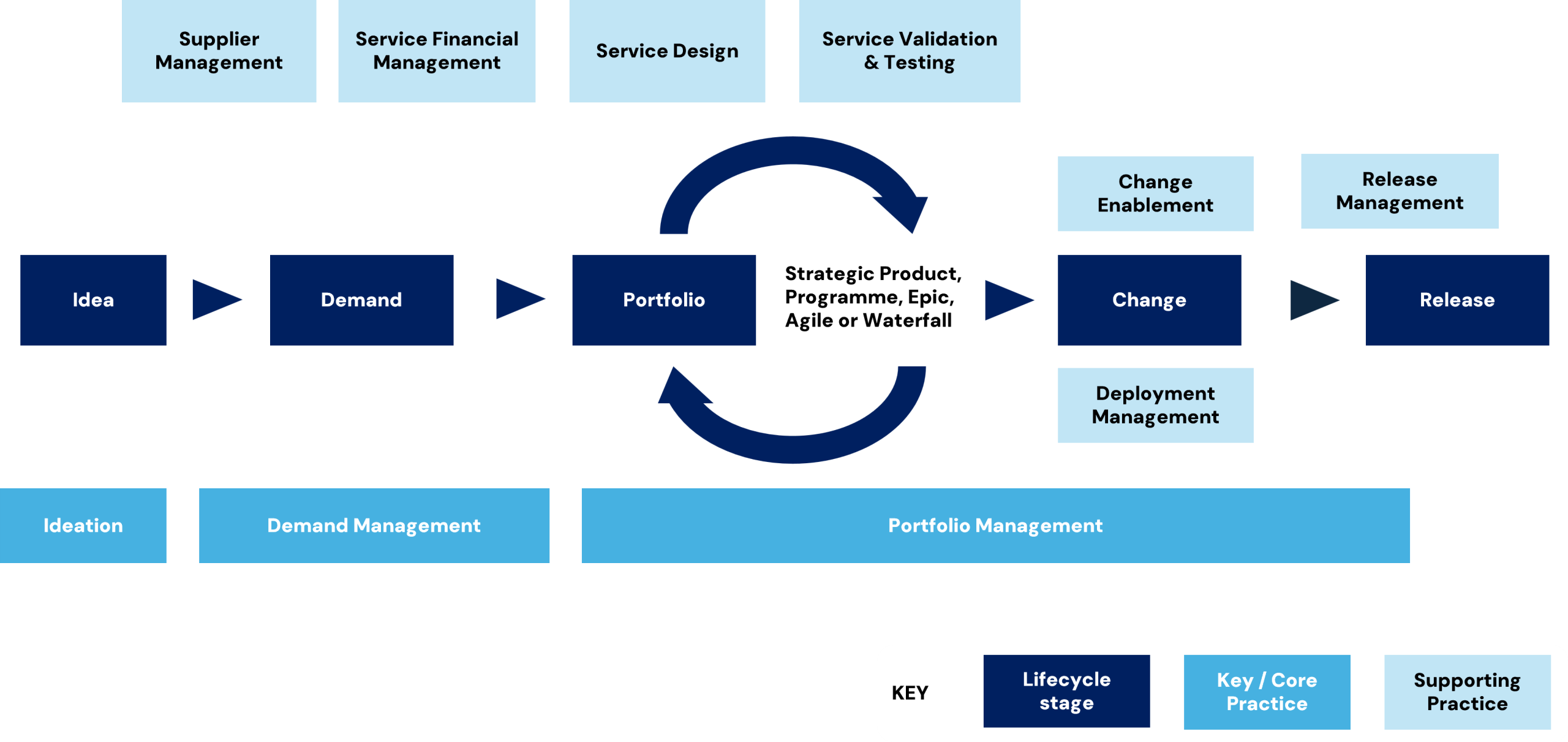
The following diagram shows the Change Office’s remit across the entire delivery lifecycle.
The key practices to be discussed here are Demand Management and Portfolio Management both of which interface with the remaining practices at various points during the lifecycle. The Change Office focusses heavily on Ideation, Demand Management and Portfolio Management to provide full visibility of the change portfolio and makes use of the following practices to support other change office processes:-
- Supplier Management
- Service Financial Management
- Service Design
- Service Validation and Testing
- Change Enablement
- Deployment Management
- Release Management
It is worth noting that the Change office plays an even more integral role within a multi-supplier / SIAM environment, co-ordinating supplier activities to ensure coherent delivery.
When implementing a change office function Mozaic recommends that the above practices are underpinned by effective tooling support to orchestrate and automate the various change office activities.
Ideation
Ideation provides a simple and accessible mechanism to capture new ideas, enhance and vet these ideas and, if deemed appropriate develop them into new demands. Ideation serves as the initial, exploratory phase where new ideas are captured, discussed and evaluated before they are formally raised as demands. Think of Ideation as a crowdsourced, collaborative funnel into the demand process that helps organisations focus on those items genuinely work pursuing. Developed ideas will evolve into Demands and subsequently lead typically to backlog items for Product teams to deliver or discreet project deliverables in a more traditional delivery environment.
Demand Management
Demand Management encompasses:
- The capture, evaluation, profiling, forecasting and planning of incoming demand
- Enabling the business to focus on value and executing activities at the appropriate time (especially relevant in a multi-supplier / SIAM model)
- Matching supply and demand – enabling a prioritised list of demands to be schedules based on available resources and / or enabling better forecasting of resource demand based on the visible pipeline of work
- The high-level estimation of new demand and decision making
- Reporting and provision of Demand information to Stakeholders
- Monitoring progress of demand through the process
- Measuring the effectiveness of the Demand Management process e.g. through agrees KPIs
- Continual Improvement – Demand Management takes input as new demands from the Continual Improvement Process
Having a well-defined and managed view of demand provides the business with valuable insights into patterns and trends for IT services. Analysis of this data can then enable more informed decisions to be made about investments and strategic priorities. At an operational level understanding demand enables organisations to allocate resources more efficiently, helping to balance demand for resource with capacity. A clearly defined demand process, underpinned by tooling, enables all stakeholders to have full visibility of emerging demands and their process through review and approvals providing much needed transparency to all stakeholders.
As part of the demand management process the IT Change Office will co-ordinate with suppliers via the Supplier Management & Service Financial Management practices to share requirements for proposals, review and consolidate responses and, once validated, engage suppliers to initiate the activity and then handoff control to Portfolio Management.
Service Design requirements should be factored into responses to demand requests and subsequent Service Design activity built into delivery plans.
Portfolio Management
Portfolio management within the change offices provides the organisation with a view of all inflight activities and their key attributes. The Change Office is not trying to replace or duplicate the activities of a PMO (Project Management Office) but is interested in key milestones throughout the project lifecycle such as design sign-off and readiness checks prior to implementation or service transition. These milestones along with a view of project RAG status and any relationships and dependencies with other projects form the basis of the Change Office view of the portfolio and help to ensure that upcoming changes are understood, conflicts with other planned changes and business-critical periods can be avoided and ongoing operations are not impacted. This portfolio view is important to the Change Office as it captures dependencies, risks and issues across projects enabling the prioritisation of mitigations or associated actions.
Where an organisation has adopted the use of stage or quality gates to manage the delivery lifecycle then tracking progress against these gates as milestones can provide a very effective view of overall status of the portfolio and well as enabling key reporting such as showing which projects are in development, in testing, approaching go-live or in early life support.
In an Agile or Product centric model then tracking progress against stories and epics provides an excellent view of overall status with releases enabling delivery progress to be tracked over time. Whilst a product team will be in control of it’s own backlog the ideation process can provide a valuable source of new items for consideration whilst the portfolio view will highlight any dependencies, resource conflicts and such like.
Portfolio Management provides a regular cadence of review and reporting to track and manage the portfolio including but not necessarily limited to the following:-
- Track overall RAG status and progress against key milestones;
- Identify and track key risks and issues and seek to mitigate;
- Identify and track dependencies between portfolio items and track these to enable effective management of the portfolio including any mitigating activities should dates for dependent activities move beyond acceptable limits;
- Identify and track any constraints that may affect portfolio delivery such as key resources (e.g. environments) which may impact the sequence in wich the portfolio can be delivered;
- Ensure that supporting practices and activities have been completed so that the project can progress to the next stage (e.g. Service Design has been completed, Service Validation and Testing has been undertaked, criteria to initiate Deployment and Release activities have been met).
Portfolio Management interfaces with the other practices during the lifecycle of each project as follows:-
Service Design to identify potential risks early in the project lifecycle and plan for mitigation. This proactive approach reduces the likelihood of service disruptions and ensures compliance with regulatory requirements. Service design helps ensure that IT services are crafted to support and enhance the organisations objectives. Service Design also helps the organisation identify critical business services and dependencies, what support they require and make informed decisions around the lifecycle and expenditures.
Service Validation and Testing to reduce risks and uncertainties that new or changed products and services may introduce to the production environment through the planning and execution of appropriate tests. Service Validation is carried out in the earlier stages of the lifecycle to confirm that the design meets agreed service requirements. It also establishes acceptance criteria for subsequent stages (development, deployment and release) which are verified through testing. Service Testing takes these criteria and creates test strategies and plans and then ensures these have been executed / implemented.
Co-ordinating with Change Enablement to facilitate the various changes needed to progress through the lifecycle, specifically with regard to Deployment and Release Management.
Deployment Management to manage the movement of the service or component into a designated environment ensuring the controlled and efficient deployment to different environments. From a Change Office perspective, the focus is on ensuring that any specific pre-requisites have been met before service or components are moved into new environments, again this is particularly important in multi-supplier / SIAM models where environments may be shared across suppliers.
Release Management to make the service, component or features available for use. Ensuring that the most appropriate model is chosen to enable the service for new users by minimising risk and providing a seamless and timely release of IT services.
Implementing an IT Change Office
“The future is already here – it’s just not very evenly distributed” – this famous quote by the author William Gibson is often referenced to demonstrate how advanced ideas or technologies often emerge in isolated pockets before becoming widespread. In the context of an IT Change Office all of the building blocks are already available, the ITIL practices are well defined as is the broader delivery lifecycle; they simply need to be implemented and connected together in an effective and coherent manner so as to provide the full view of all prospective and in-delivery work within an IT organisation.
Defining and implementing clear processes for Demand and Portfolio Management as well as the supporting practices is key to ensuring that the Change Office activities are well understood as are any interfaces / touchpoints with other organisational structures and processes such as the Project Management Office and the Service Management teams.
Tooling support is also key to enable an effective and functioning Change Office. Again this tooling is already widely available and in many cases is often already in place within an organisation and can be leveraged to support the Change Office. Typically a Change Office would make used of tooling in the following areas:-
- ITSM tooling for change enablement;
- Configuration Management Database (CMDB) to track the relationship between IT assets and understand the impact of changes;
- Project and Portfolio Management tooling to provide visibility of project timelines, resource requirements, dependencies etc;
- Collaboration and communication tools to enable notifications, discussions, and approvals relating to demands, project status, change etc;
- Analytics and reporting to provide visualisations and dashboards to track key metrics across demand and portolio management;
- Risk and compliance to manage risks and support risk assessment for changes.
By integrating these tools, the IT Change Office can operate with greater efficiency and control. Enabling streamlined workflows, robust compliance and ongoing improvement aligned to business objectives.
A world-class IT Change Office is fundamental to delivering business value through stable and responsive IT services. By embedding governance, risk management and continual improvement into its framework, the Change Office ensures that all changes align with the organisation’s strategic goals. Integration of the Change Office with the PMO (Project Management Office) ensures seamless project transitions into operations, whilst alignment with ITIL 4 practices enhances agility and operational resilience
In summary, an IT change office acts as the gatekeeper, facilitator and quality control for IT changes, balancing the need for innovation and agility with the need for stability and continuity.
So, What Should I Do?

- Assess current capablity – take a close look at the existing processes and functions your organisation has in place verus the activies that a change office will deliver. Assess the maturity of existing processes and identify any gaps against the Change Office processes.
- Define clear processess and handoffs to other areas – review process / practice documentation to make sure that there is a clear workflow supported by defined roles and responsibilities and interfaces to other functions and activities.
- Design and implement change office processes with tooling support – determine what tooling (exisiting or new) can be used to support the key change office functions, build and implement an MVP and then continue to enhance the process and tooling through continuous improvement and feedback.
Written by Andy Donnelly, Principal Consultant
If you’re struggling to get full visibility of your change portfolio, looking to drive more strategic IT investments, or exploring ways to enhance decision making to enable effective delivery, we encourage you to get in touch.
Related Insights


Contact Us
Get in touch with our team to learn more about our services, explore partnership opportunities or discuss how we can help with your challenges.