

Powering Enterprise Product
New data-driven AIOps techniques enable automatic, intelligent, event correlation and proactive Digital management using big data to attain deep, real-time insight, predictive analysis and automatic resolution. In this way, you can achieve greater stability, security and resilience across your estate, and achieve significantly faster incident resolution.
Technology estates are now virtual and dynamic, with both infrastructure and software defined in code, and subject to continual change. Understanding the makeup of these estates is fundamental to all aspects of secure, resilient, performant and cost-effective management. Traditional Service Management techniques that rely on maintaining a CMBD through Discovery snapshots are no longer relevant – the pace of change is simply too quick, and the level of configuration data too dispersed.
Continuous, Rapid Change
Effective Digital delivery relies on a comprehensive and current understanding of your estate and of the potential impact of change; lack of visibility can lead to expensive delays, performance issues and failure.
Unfortunately, in a fast-changing cloud-first, Digital world, where release cycles are increasingly short, and infrastructure is virtualised and dynamic, traditional ways of mapping your estate are no longer appropriate. The challenge is further exacerbated as responsibility for the delivery of products and services is devolved to DevOps teams – critical configuration data now sits within local, siloed tools (i.e. code repositories) whilst the systems are reliant upon interdependent platforms delivered and managed by others.
The World of Service Delivery
Widespread investment in Service Management platforms and the implementation of comprehensive CMDBs have been the backbone of good service management; supporting troubleshooting, problem resolution, strategy planning and proactive change initiatives. However, building a CMDB and related service maps is a resource intensive task, and ensuring it remains current, and therefore useful, is extremely challenging.
This is true in a traditional, physical world where devices, assets and configurations are largely static. However, in a cloud-first, elastic, dynamic world, the challenge becomes nigh on impossible.
As a result, operational costs have increased, change and release cycles have stymied innovation, and quality has dipped. Organisations are struggling with higher volumes of change failure – as high as 10% has been reported in some areas.
The Future, Now
The solution lies in the recognition that the data for “everything as code” is already available in abundance in a diverse set of tools and locations across your virtual estate; including code repositories, incident reports, performance logs, application logs, and cloud metrics.
Using proven big data techniques, these disparate, federated data sources can be aggregated, harvested, and analysed to provide a comprehensive real-time understanding of your estate; enabling automatic, intelligent root cause analysis; identifying correlations between seemingly unconnected events; spotting anomalies; learning and applying tolerance thresholds; and automating resolution.
Given the volume of data and its disparate nature, this level of analysis and insight simply cannot be achieved manually or through snap-shots using discovery tools; and yet it is essential for the secure and resilient delivery of digital services. AIOps is the only viable solution.
This data-driven approach is proven across many industries over many years and is already widely used to provide predictive analytics and business insights in finance, retail, and engineering.
The approach in Digital is similar to that employed by aircraft engineers, where detailed jet engine telemetry is analysed continually to proactively identify and address potential issues. Similarly, pit systems in Formula 1, continually monitor every aspect of a car’s performance, including engine behaviour, fuel consumption, tyre wear, brake wear, grip, and acceleration. In this way, engineers gain a real-time understanding of performance to proactively address issues and tune the systems.
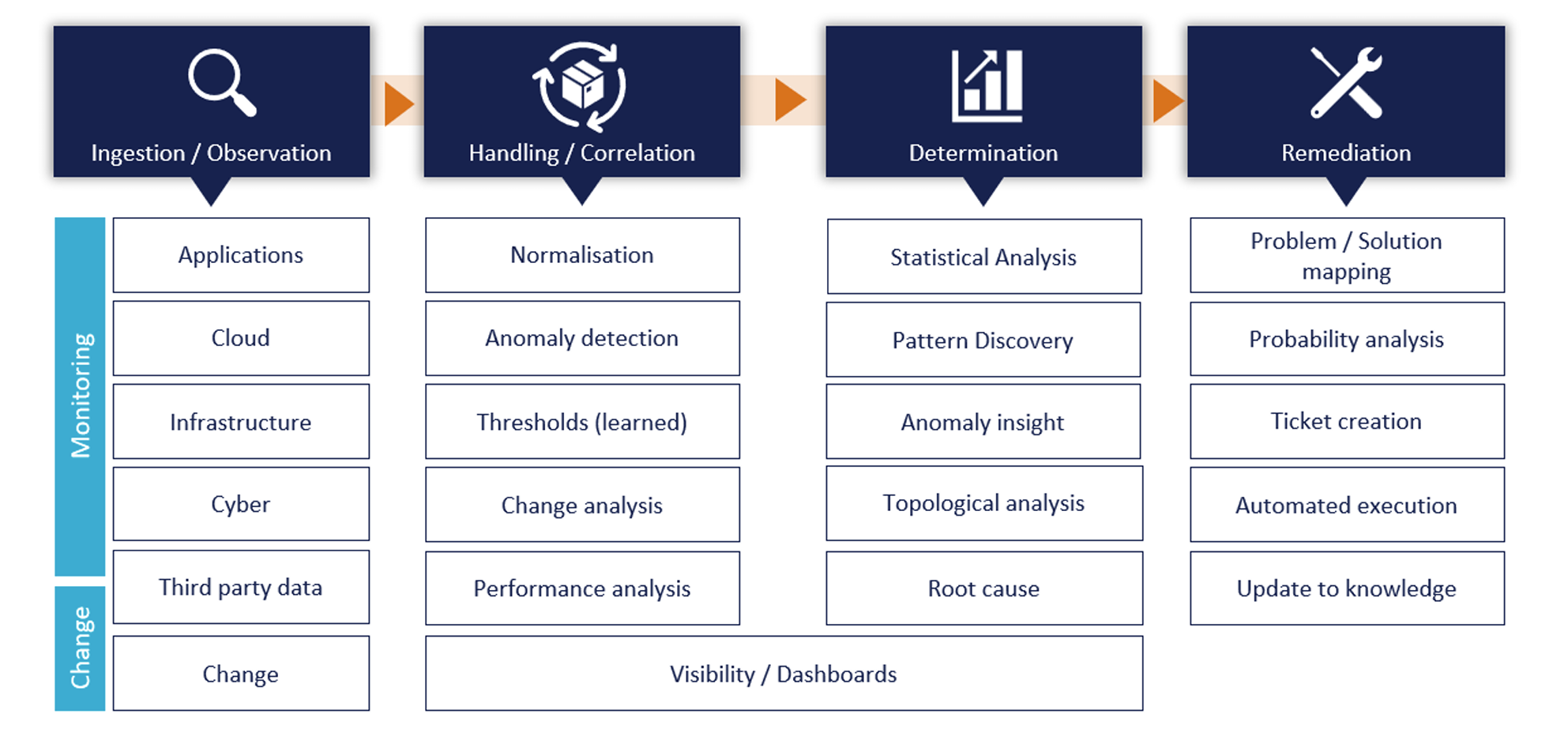
Using machine learning provides a deep understanding of what is really happening across your estate, correlating events, providing deeper insight into performance, enabling failure to be predicted before critical impacts occur, and accelerating and automating incident resolution.
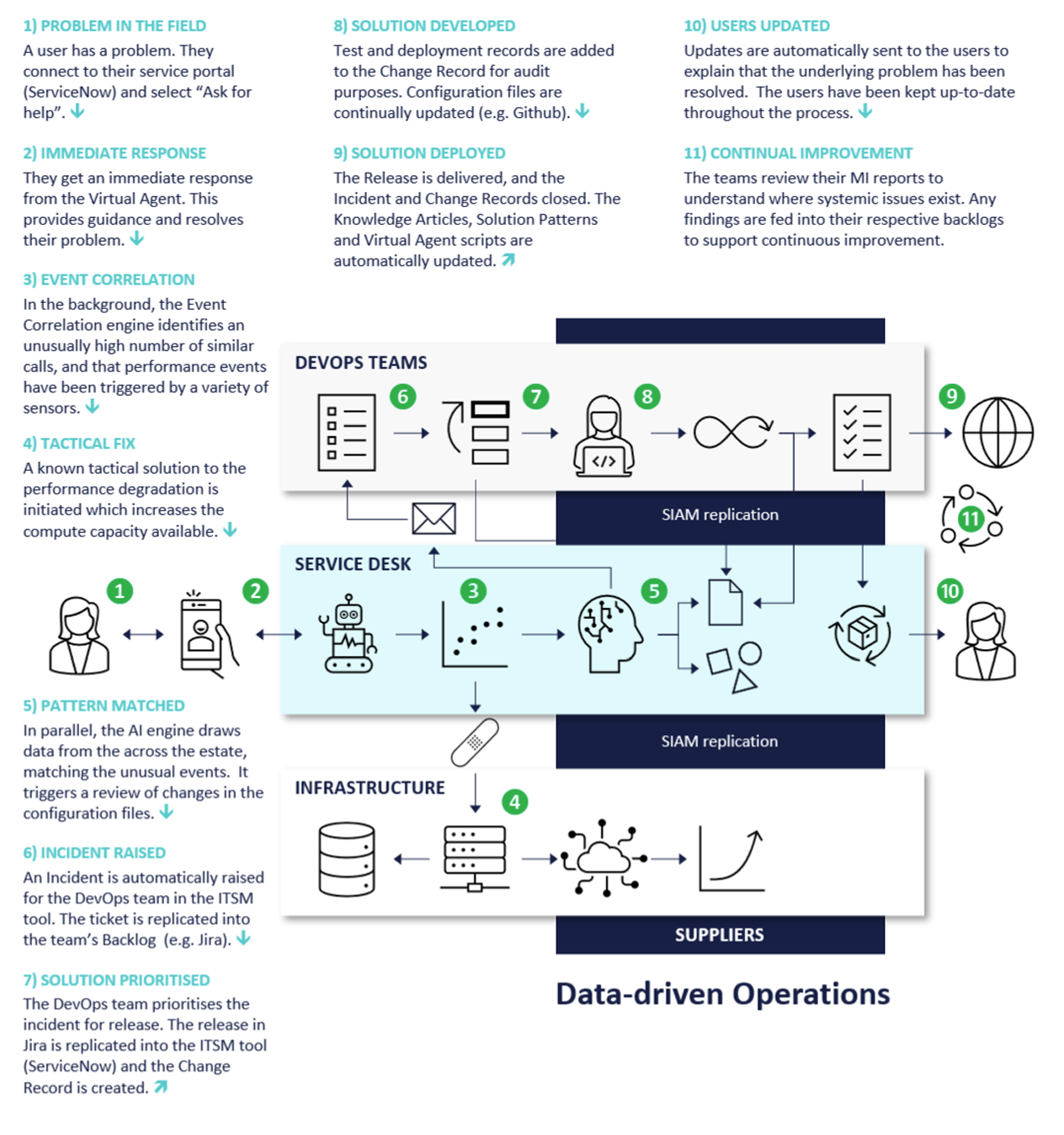
Data-Driven Operations
Where to Start?
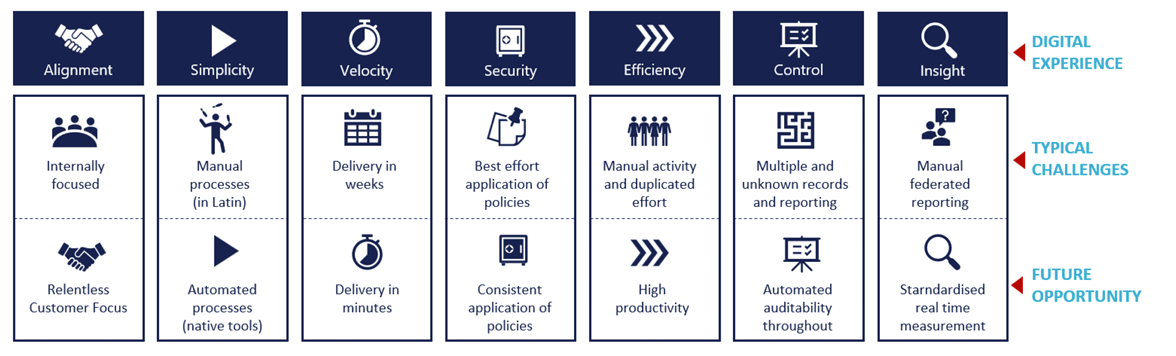
AIOps is a key enabler for modern Digital organisations, and as such it addresses many of the Themes of Digital Excellence (see below). These Themes can be used to assess the prevailing context and prioritise implementation.
You probably already have a suitable platform available on which to implement data-driven operations. For example, ServiceNow offers a comprehensive solution within its standard modules – modules you may have already paid for and installed.
The complexity of the roll-out roadmap is, of course, proportional to the complexity of your estate. Success of this approach is dependent on the discovery, ingestion, aggregation, and analysis of data; the harder it is to access this data, the more difficult the implementation project will be.
For example: are you subject to prohibitive security requirements and therefore heavily locked down; how many third parties provide parts of the portfolio, and are they “black boxes”; and how widespread is the integration with peripheral systems?
Fortunately, the task can be sub-divided into smaller, easier to manage, tranches – it is often not necessary (or appropriate) to tackle your entire estate in one go. Mozaic recommends an initial focus on a single product line, one that provides the greatest value and interfaces with the largest audience.
Having identified and agreed on the initial exemplar, the system should be set up and initial event patterns and thresholds identified. Of course, once the system is live, it will immediately “learn”, identifying new patterns and correlations, and redefining thresholds.
It’s Time for Action
Over the last few years, IT estates have changed fundamentally and yet, to date, few organisations have changed the way in which they manage and deliver services. As a result, costs, failure rates and risk are increasing. It’s time to think differently – holding on to existing working practices is simply not practicable.
Implementing a data-driven approach provides deep, 360-degree visibility across the IT estate. Using AI and big data techniques provides predictive analytics and automated root cause analysis. It will significantly reduce escalations, downtime, and the time spent managing your estate.
According to a study reported by ServiceNow, front-line customer support functions spend up to 12% of their time managing tickets, and 43% of IT service desk respondents are weighed down by having to choose from hundreds of assignment groups.
The results are compelling, studies show reductions of up to a 50% in IT Service Management costs, 50% reduction in Mean Time to Resolution (MTTR), and 90% in level-one incidents.
Related Insights


Contact Us
Get in touch with our team to learn more about our services, explore partnership opportunities or discuss how we can help with your challenges.