

Maturity is not how clever your models are. It is how your organisation measures value, spends its money, and decides what to do next. That distinction is the whole game.
Every leadership team has a version of the same conversation. Someone asks how far along the organisation is with AI, and the answer arrives as an inventory: a copilot rolled out here, a chatbot there, a dozen pilots in flight, a language model wired into the data warehouse. It sounds like momentum. Usually it is motion without direction. A wall of pilots tells you a company is busy, not that it is scaling, and the two are easy to confuse right up until the budget review, when nobody can say what any of it returned.
The uncomfortable truth is that maturity has almost nothing to do with the sophistication of the models. Drop the most capable system on the market into an organisation that treats AI as an IT cost and measures it by activity, and you will get a brief flurry of local productivity followed by a stall. Pile up a hundred disconnected experiments and you have not built a capability; you have built fragmentation with good marketing. What actually separates the companies pulling ahead is duller and harder to buy: clarity about who owns AI, guardrails that let it run safely, funding that follows evidence, and the discipline to measure the things that matter.
The five stages, and the sentence that gives each one away
It helps to name the ground you are standing on. We use a detailed model in diagnostics, but the shape of the journey is consistent, and each stage has a tell, a sentence the organisation keeps saying about itself. At the start, Experimenting, the line is “we’re testing AI”: enthusiasts trying off-the-shelf tools, literacy patchy, value more hoped for than measured. Next comes Operationalising, “we’re making AI work”: a real intake process, models running in production under proper controls, the first agent-assisted workflows nervously watched. Then Scaling, “we’re scaling AI”: investment run as a portfolio, ownership shared across functions, AI stitched into the teams that deliver products and operations. Further up is Transforming, “AI is reshaping how we operate”: compound and agentic workflows carrying real load, AI starting to shape customer experience and where the capital goes. And at the leading edge, the self-optimising, adaptive enterprise, “our enterprise adapts continuously”: agents working within trust frameworks, the operating model retuning itself from live signal, whole new business models appearing that were not possible before. Almost no one sits cleanly in one stage. Governance can lag while technology races ahead, which is precisely the information a single maturity score throws away.
What actually changes as you climb
Look closely at the organisations moving up the curve and the same three things shift, none of them technical. The first is how value is measured. Early on it is a local win, a few hours saved in one team, quietly pleasing and strategically irrelevant. Mature organisations measure cost per outcome across a whole value stream and can point to AI’s contribution in real money. The second is how investment is prioritised. Early on, budget follows enthusiasm and the loudest sponsor. Mature organisations run a single portfolio with honest stop-or-scale checkpoints, so capital flows to what earns it and starves what does not. The third, and this is the summit, is how far AI is allowed to shape capital decisions. Low down, AI informs an operational choice. High up, AI performance shapes where the organisation invests and how it competes.
AI maturity is about how the organisation’s capital and operating decisions adapt, not about how clever the models are.
That progression looks different in every corner of the business but keeps the same shape. In pricing, AI begins as decision support, becomes a lever managed at portfolio level, and ends up influencing capital allocation itself. In customer operations, it starts by trimming handle times and ends by actively protecting and growing customer lifetime value. In HR, it moves from a handy case-assist tool to something that shapes policy and workforce planning. Decision support, to managed lever, to strategic influence, every time.
One dimension refuses to wait its turn: governance. It is the thread running through everything else, and the line between value that compounds and risk that compounds. Bolt it on after pilots reach production and it becomes debt, a retrofit everyone resents. Design it in early, written into the platforms and workflows AI actually runs through, and it becomes an asset the board can stand behind. Maturing governance early is not timidity. It is the thing that makes the later stages survivable at all.
And none of this is a finish line. Stage five is simply the furthest edge visible in front-runners today, and four horizons are already forming beyond it: enterprises where fleets of agents coordinate within trust frameworks, AI that informs strategy rather than just execution, value shared across ecosystems of suppliers and partners, and operating models built for AI from the ground up rather than bent around it. Being future ready does not mean sprinting to stage five and stopping. It means building an operating model supple enough to absorb each of those horizons as it arrives, without tearing everything up to start again.
Which is the real point. Maturity models earn their keep only if they change what you do on Monday morning. Ours is built to. The Mozaic AI Diagnostic reads an organisation across all seven operating-model dimensions and five stages and hands back a heatmap, a prioritised list of gaps and a roadmap you can act on, replacing a comforting single score with an honest picture of where you actually stand. Because in the end the winners are not the companies running the newest models. They are the ones that have deliberately designed how value, money and decisions adapt.
What Next?
Find out where your organisation really sits
Start with the AI Scaling-Readiness Diagnostic, a structured read of your maturity across all seven operating-model dimensions.
Scale AI With Confidence
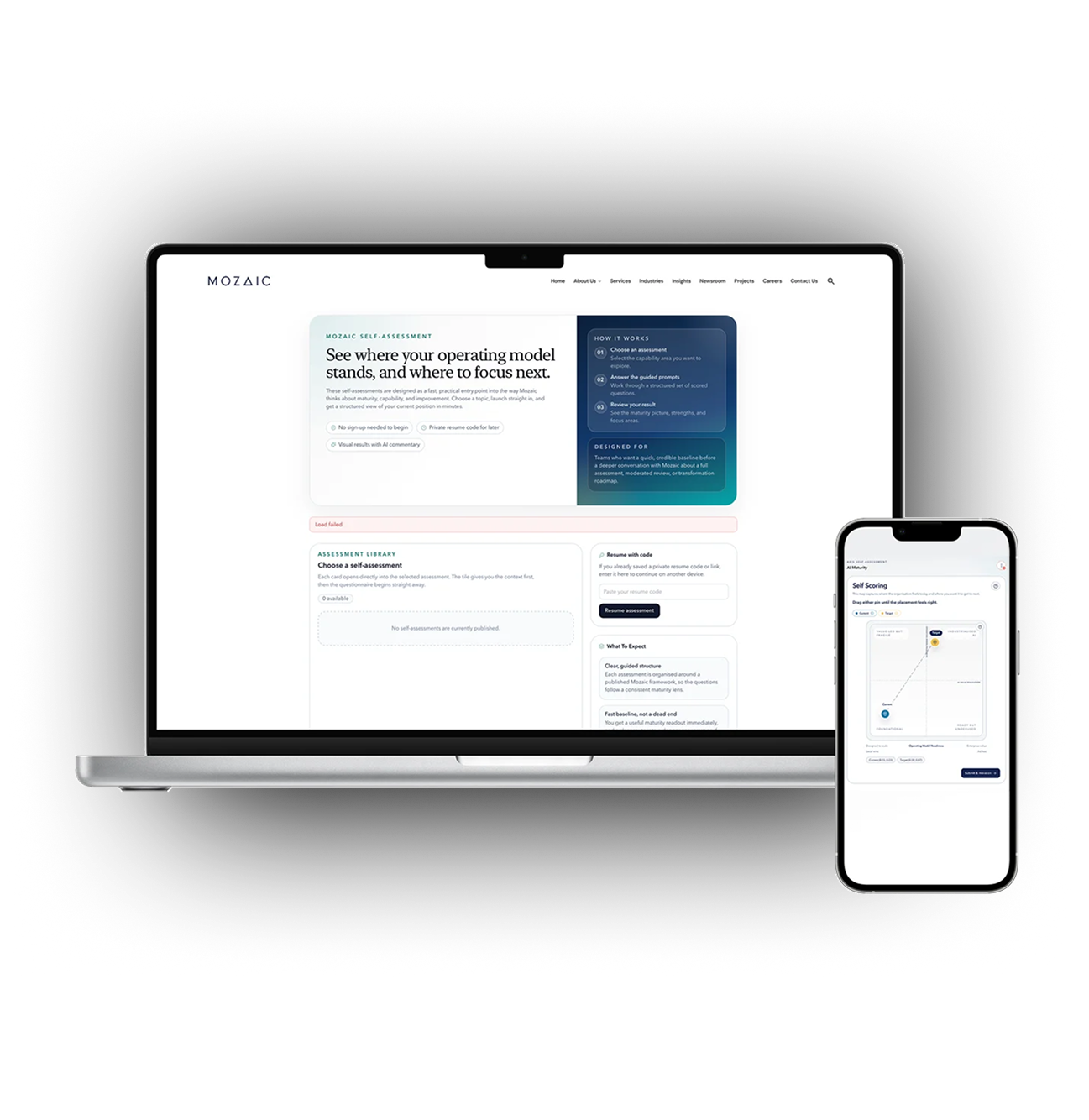
A faster, smarter way to understand how ready your organisation is to scale AI. Our new AI Value Scaling Assessment transforms structured insight into clear priorities, practical recommendations, and measurable next steps.
Related Insights


Contact Us
Get in touch with our team to learn more about our services, explore partnership opportunities or discuss how we can help with your challenges.